Brea Divorce Lawyer

Brea Divorce Attorney

Divorce is one of life’s most difficult, challenging, and often sad experiences. For residents of Brea, California, navigating this process can be significantly easier with the right legal support. It’s essential to prepare and thoroughly complete your research before choosing a lawyer to represent you. Compare attorneys, law firms, and their online presence.

What are they saying? What are they not saying? For those in Brea, the choice is clear. If you are thorough in your research, the choice of who to hire of the 600 plus divorce lawyers in Orange County is not difficult.

Minyard Morris has been serving your community since 1977. For over 46 years, we have dedicated ourselves to supporting Brea and Orange County residents in their family law matters. Our team of 20 divorce lawyers boasts nearly 350 years of combined experience, exclusively focusing on family law cases filed in Orange County.

Among our team, 9 are Certified Family Law Specialists, certified by the California State Bar. In 2024, the preeminent independent lawyer rating service BEST LAWYERS IN AMERICA listed 19 of 20 Minyard Morris attorneys.

Our firm’s growth and success stems from our commitment to listening to and hearing our clients, understanding their objectives, and working tirelessly to achieve their goals. We prioritize client service and strive to resolve cases efficiently so our clients can begin the next chapter of their lives at the earliest opportunity.

We aim to find solutions from the very beginning, rather than waiting until the eve of a trial or a hearing.

Our Orange County Family Law Services

We handle a wide range of family law matters for our Brea clients, including:

While family law encompasses child custody, domestic violence, and support issues, it primarily involves the division of a marital partnership’s assets. This doesn’t mean each party receives 50% of every asset, but rather that each party receives assets of equal value. One of our main tasks is to make certain that our clients receive at least their fair share of the assets.

Valuing and dividing assets seems simple. Sometimes it is and often it is not, dividing cash, a bank account or a stock account is generally easy. However, in order to arrive at an equal division of an estate that includes, illiquid investments, real estate, businesses, intellectual property, or collectibles, the assets must be valued.

Valuing these assets is often very complex. If your estate has these complexities, you need a divorce lawyer with experience in this area of the law. Minyard Morris has lawyers who handle these types of cases and it has lawyers who handle the normal Orange County divorce at substantially lower hourly rates.

Dedicated Brea Divorce Attorneys

If you are a resident of Brea seeking experienced and dedicated legal representation for your divorce, consider Minyard Morris. Our expertise and commitment to client service can successfully help you navigate this challenging time with confidence. Call 949-724-1111 or use our confidential contact form to arrange your initial consultation.

Brea Divorce Lawyer FAQ

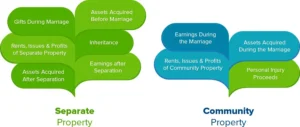
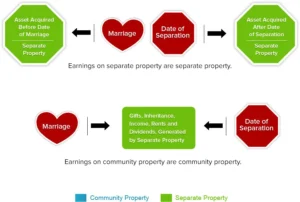
Although defining community property and separate property seems very straight forward, often the issues are extraordinarily complex. Separate property, as defined in California, is an asset owned prior to the date of marriage, acquired after the date of separation, or acquired after the date of marriage and prior to the date of separation by way of inheritance or gift as it is defined by the California Family Law Code. Community property is defined as an asset acquired after the date of marriage and prior to the date of separation, unless the asset was acquired by way of inheritance or gift as it is defined by California law. Income, rents, and dividends generated by separate property are separate property.

Community Property

Separate Property

Tracing may be used to uncommingle bank or brokerage accounts and to trace separate funds used to purchase an asset that is titled in joint names. Tracing is also used relative to certain reimbursements to the separate property of one spouse or to the community.

Direct Tracing

The second method of tracing is referred to as the Family Expense or Recapitulation method. This method may be used when the records that would prove the tracing do not exist to complete a direct tracing and the unavailability of the records is not the fault of the party seeking to trace his or her separate property.

The divorce court may conclude that the asset in question was purchased with separate funds, if the party can prove that at the time of the purchase transaction, there were no community funds available to make the purchase. This may be proven by demonstrating that the community expenses at the time of the transaction equaled or exceeded the community income, thus showing that there could not be community funds in existence.

Community expenses paid with funds from a commingled (containing community and separate funds) account are presumed to be paid with the community funds contained in the account, as opposed to one spouse’s separate funds contained in the same account. This rule is referred to as the “community expense presumption.” In other words, the community funds in a commingled account are used first, if the expenditure is for community expenses.

Family Expense (Recapitulation) Tracing

The State Bar of California recognizes divorce as a specialized practice area. Representing clients in divorces that involve the valuation of business interests is even more specialized. Handling these matters requires a working knowledge of family law valuation principles, taxation, compensation issues, accounting principles, general foundational business knowledge, and the complex and conflicting divorce valuation, case law, and divorce litigation practicalities.

Representing a party in a divorce involving a business interest requires the retention of a divorce business valuation expert. They can be invaluable in negotiation and reaching a settlement, as experts often collaborate to reconcile differences in their findings and opinions. In many cases the divorce court will actually order the accountants to meet and confer long before the trial to attempt to resolve their differences.

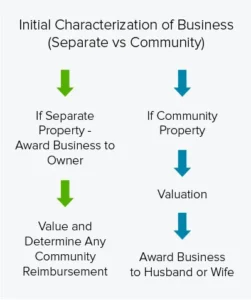
Initial Characterization of Business

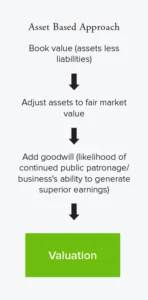
Asset Based Approach

Income Based Approach

The Direct Tracing Method is the favored method of tracing. Direct tracing requires the transaction by transaction tracing of funds from a separate bank account or source into the purchase transaction. The separate funds must be shown to have been present in the bank account on the date when the purchase transaction occurred. There may be additional factors that come into play for the tracing to be successful. If separate funds were transferred into a community account prior to the purchase transaction, each transaction occurring between the deposit and the subject transaction must be analyzed. Specific detailed tracing requirements must be met.

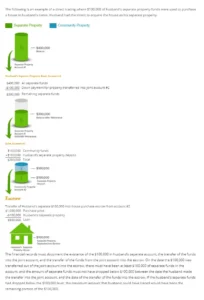
For example, if a husband was attempting to trace $100,000 into a real estate purchase escrow account the tracing exercise could look like the steps set fourth below. The documents must show the existence of the $100,000 in husband’s separate account, the transfer of the funds into the joint account, and the transfer of the funds from the joint account into the escrow. On the date the $100,000 was transferred out of the joint account into the escrow, there must have been at least $100,000 of separate funds in the account, and the amount of separate funds must not have dropped below $100,000 between the date the husband made the transfer into the joint account, and the date of the transfer of the funds into the escrow. If the husband’s separate funds had dropped below the $100,000 level, the maximum amount that the husband could have traced would have been the remaining portion of the $100,000.

Direct Tracing Example

California divorce courts characterize and value retirement plans in a divorce based upon these and other factors depending on the details of each specific plan:

  • Type of plan;
  • Increase in plan value during the marriage;
  • Contributions to the plan during the marriage;
  • Specific contractual terms of the plan;
  • Performance of plan assets;
  • Age of the employee;
  • Years of employment before and after the marriage;
  • First possible retirement date; and
  • Survivorship options

California divorce courts generally allocate retirement plan benefits between separate property and community property according to when the benefits were earned. Benefits “earned” during the marriage (after the date of marriage and before the date of separation) are generally characterized by divorce courts as community property. Benefits “earned” before the date of marriage or after the date of separation are generally characterized as separate property. Complications may occur relative to dividing the earnings of the plan assets, when records are missing, when valuing a defined benefit plan and when drafting a Qualified Domestic Relations Order.

Two Basic Types of Retirement Plans

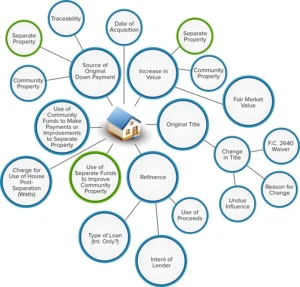
California family law courts allocate the increase in equity in real property during the marriage to the community and/or the separate property of the parties based on a number of factors:

  • Changes in title
  • Date of acquisition
  • Source of funds used for acquisition, improvements and/or principal payments on a loan
  • Increase in value
  • Refinancing

Real Property Issues and Factors

There are two basic types of tracing:

  • Direct Tracing Method (mechanical tracing)
  • Family Expense (Recapitulation) Method

Tracing can be used to benefit either the separate property of one spouse or the community. Tracing can be very expensive and a party generally will not know if the tracing will be successful until after it is complete.

The court has the authority to allow tracing that does not totally comply with the traditional tracing rules so long as it does not rely on speculation and does not violate any other family law principles.

Family law is made more complex than is generally thought because the courts follow the Evidence Code and the Code of Civil Procedure.

A trial in a divorce case is not dissimilar to a trial in other civil or business litigation with the exception that divorce cases do not involve a jury. The California Code of Civil Procedure and the Evidence Code must be followed. Trials may be very complex proceedings that are often lost due to a lack of understanding of procedural rules or the rules of evidence.

Evidence, Presumptions and Privileges

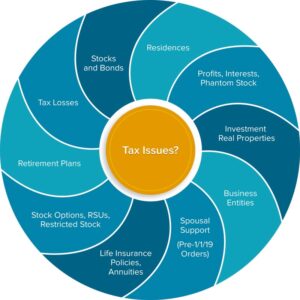
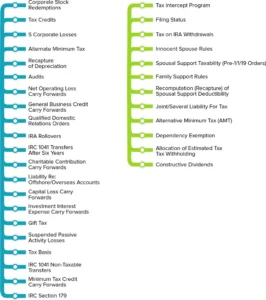
Tax issues cannot be ignored. Often, tax issues are not identified until it is too late to manage or structure around them. Tax is yet another area of sophistication that must be addressed in a divorce. Tax plays a role in many, if not most, divorce cases. Divorces involve income and assets that frequently have tax related issues.

Tax issues may impact the actual values of many asset categories and decisions as to whether an asset is desirable to a party. The following issues and assets should be analyzed early in the divorce.

Tax rules and regulations must be strictly adhered to in order to avoid additional tax, penalties, and interest. The Internal Revenue Code (IRC) is a minefield in enemy territory, but the IRC provides a map detailing the exact location of the explosives. Unless you are familiar with the IRC, you run the risk of unexpected and costly surprises.

Tax Issues

Tax Issues in Family Law

Testimonials

HEAR FROM MINYARD MORRIS CLIENTS

Contact Us

SCHEDULE A MINYARD MORRIS CONSULTATION

Contact Minyard Morris now to schedule a consultation with our attorneys and legal professionals.