
Frequently Asked Questions Regarding Family Law Matters
Our FAQ section offers detailed information about a full range of important questions that affect divorce cases. The responses address key subjects including business valuation, child custody, spousal support, modification of orders and more. Click on the dropdown menu for a full list of topics, then choose the specific questions applicable to your situation.
Questions related to:
Allocation Of Stock Options
Stock options granted during the marriage and/or partially vested during the marriage may have a community property component. Stock options that are partially earned during the marriage are allocated between community property and separate property. The foundation for this allocation is the statutory law that provides that “earnings” during the marriage are community property. If a spouse is compensated during the marriage, in part, with a grant of stock options that partially vest during the marriage and partially vest after the date of separation, the stock options will most likely be partially community property. If a spouse’s employment during the marriage results in the partial vesting of stock options granted before the date of the marriage, the options will also most likely have a community property component. The number of options characterized as separate property or community property will vary depending upon which formula is used by the family law court.The time rule is used to allocate options between community property and separate property. The time rule does not determine characterization. The characterization of an asset is determined by when the right to the asset was accrued.
Are a Child’s Special Needs Relevant to a Child Support Order?
Child support is paid to address a child’s needs. A divorce court may take into consideration the special needs of a child when determining the amount of child support. The court may also consider the history of private school attendance and the reasons for private school. A child support order that merely pays for a child’s necessities may not be sufficient, if the parents can afford to pay for more.
Are Actual Hearings Required in Domestic Violence Matters?
Credible evidence of a party intentionally or recklessly causing or attempting to cause serious bodily injury, whether intentional or not, constitutes abuse under the Domestic Violence Protective Act. A family law court may not dismiss a request for Domestic Violence Protective Act restraining orders without a hearing, if the pleadings are factually adequate relative to the abusive acts (Nakamura v. Parker).
Conclusion accusations of domestic violence do not constitute sufficient evidence to support a finding of domestic violence (A.G. v. C.S.).
Are All Child Custody Lawyers Created Equal?
If a party elects to engage in child custody litigation, the selection of the Orange County divorce lawyer should be made very carefully. The selection of the right divorce lawyer can often be the difference between a victory and a loss. Use common sense in determining who to hire. Study a lawyer’s website, evaluate their reviews to assess their credibility, and most importantly, interview the specific lawyer who will try your case, if your matter goes to trial.
Are All Permanent Spousal Support Orders Modifiable?
A permanent spousal support order may be modified by the divorce court upward or downward if there has been a change in circumstances (IRMO Clements).

Spousal Support is Modifiable
Are Contributions to Retirement Plans During the Marriage Community Property?
If a plan, or part of a plan, was earned during the marriage, that part will be characterized as community property. There may be issues as to when a retirement plan, or a portion of a retirement plan, was earned. The divorce court determines which part of a plan is community property using case law and the date of separation. The earnings, accumulations and losses relative to the community interest in a plan will be characterized as community property.
Are Domestic Violence Cases Between Cohabiting Non-Married People Handled by the Same Courts That Hear Divorce Cases?
Abuse, or threats of abuse between persons who have been in an intimate relationship, or people that are related by blood, may be domestic violence. Abuse is widely defined, and may be sexual, physical, and/or psychological. It may include blocking someone’s path, holding them down, shoving them, throwing an item, or pulling hair. Hurting someone, whether purposefully or recklessly, may be domestic violence.
Perpetrators of domestic violence may be found to be an unfit parent, and the issuance of a protective order into the California Law Enforcement Telecommunications System (CLETS). If the perpetrator has contact with a police officer, they will see the protective order filed in the CLETS system.
A finding of domestic violence may be significant regarding to child custody, child support, and kick-out orders from the residence. Examples may include:
- A perpetrator parent must overcome the presumption that it is not in a child’s best interests for them to have joint custody with the other parent;
- A perpetrator may be required to attend a 52-week batter’s program;
- A perpetrator will be regarding ownership and possession of firearms;
- A perpetrator is subject to payment of restitution; and/or
- The perpetrator may be ordered to pay the victim’s attorney’s fees.
A restraining order may protect family or members of the protected party’s household.
A permanent restraining order, issued by the family law court, may be granted for up to five (5) years, and be extended for a lifetime.
The family law court may look at past acts of abuse, and shall consider the totality of circumstances when determining whether to grant or deny a protective order request.
Are Evidentiary Objections and Privileges Relevant in a Divorce Trial?
Family law trials, like civil litigation and business litigation are controlled by the Code of Civil Procedure and the Evidence Code. The parties, witnesses and frequently expert witnesses are called to testify.Like in all types of litigation, lawyers must have a strong command of the rules of evidence, presumptions, and privileges in order to present their case to the court.
Are Expectations Relevants to a Spousal Support Order?
Reasonable expectations of the parties, expressed or impliedly expressed, in a marital settlement agreement may impact the change of circumstance test (IRMO Dietz).
Are Experts Always Retained in Child Custody Matters?
Frequently, child custody matters often do not involve experts and on occasion, more than one expert is retained by each side of a case. Whether or not to involve an expert in a child custody case is a critical strategic decision that should be carefully evaluated with the divorce lawyer. It is critical to retain the “right” expert as, with divorce lawyers, all experts are not created equal.
Are Monetary Gifts From Third Parties Considered to be Income Available for Child Support?
Payments made by family members to a party may or may not be characterized as income. If the payments are loans or advances on an inheritance they may not be income. If they are recurring gifts, a divorce court may characterize them as income. (IRMO Alter). If payments have been recurring but have ceased, they will generally not be considered income. (IRMO Williamson). The family law court has discretion to consider whether to consider gifts to be income. A family law court may rule that recurring gifts from a “good samaritan” are not income for purposes of calculating guideline child support. (Anna M. v. Jeffrey E.).
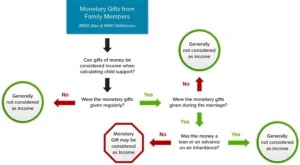
Are Monetary Gifts from Family Members Income
Are Most Child Custody Cases Settled?
The vast majority of child custody matters are not litigated and never proceed to court as parties generally settle their cases.
This infographic illustrates an example of the procedural events that could occur in child custody litigation. Not all contested child custody matters follow this exact path. Even if a matter is litigated, it is probable that there will not be a Evidence Code Section 730/Family Code Section 3111 custody evaluation. Even when a Evidence Code Section 730/Family Code Section 3111 evaluation is completed, there is a high likelihood that depositions will not be taken and that the case will be settled.

Potential Sequence of Procedural Events in Child Custody Litigation
Are Negotiations in a Divorce Like Negotiations in Most Other Areas of Business?
A divorce should not be analyzed in the same way one would analyze a typical business deal.When negotiating the purchase of a house or a company, if the buyer does not like the positions being taken by the other side of the deal, they can simply walk away from the transaction and negotiate another deal. One cannot simply walk away and divorce a different spouse. In most negotiations, the potential price and terms of purchase do not have a ceiling or floor. A buyer of raw land may be successful in negotiating an amazingly low purchase price from an unsophisticated seller.
Family law has extensive statutory and case law that provides guidance on the parameters and structure of a settlement. Experienced divorce lawyers know the range of likely results of a trial and negotiate deals that fall within those parameters.
A judge is essentially a referee who makes the final decision if the parties cannot solve the conflict. Business deals do not have an individual who solves disputes and keeps the terms of the deal fair.
Lastly, in a divorce, one party may be ordered to pay the other party’s attorney’s fees and costs. The longer the process takes, the more it may cost the higher earning party, even if that party is the reasonable and rational one. This fact may play a role in settlement positions and negotiations.
Are Parties Required to Voluntarily Provide Each Other with All Material Information About the Assets and Debts?
Parties to a divorce have fiduciary duties to one another. Fiduciary duties are wide ranging, but include the duty to voluntarily share information and documents, and to voluntarily share material facts and information related to community assets, separate assets, debts, investment opportunities, and amounts, and sources of income with the other party (IRMO Feldman). The duties continue until the divorce is finalized, and the property is divided. A breach of fiduciary duties can result in substantial financial sanctions, a 100% penalty equal to the value of the undisclosed asset, and/or attorney fees.
Are Prenuptial Agreements Subject to Attack on Contractual Terms?
Premarital and postmarital agreements are contracts. Contracts that are not well written may be misinterpreted or held to be void or unenforceable. The court In Re Marriage of McCourt offered very specific and detailed advice on drafting agreements.The fairness of most agreements is measured as of the date when the agreements are executed. (Ferguson v. Yaspan). However, the fairness or unconscionability of a spousal support waiver or limitation is measured at the time of a divorce.
If a party has full access to all of the financial and property information and material facts, he or she cannot later complain that the agreement should not be enforced unless the other party concealed facts or made misrepresentations. (IRMO Burkle).
Are Prenuptial Agreements Subject to Attack on Contractual Terms in Cohabitation?
Premarital and postmarital agreements are contracts. Contracts that are not well written may be misinterpreted or held to be void or unenforceable. The court In Re Marriage of McCourt offered very specific and detailed advice on drafting agreements.
The fairness of most agreements is measured as of the date when the agreements are executed. (Ferguson v. Yaspan). However, the fairness or unconscionability of a spousal support waiver or limitation is measured at the time of a divorce.
If a party has full access to all of the financial and property information and material facts, he or she cannot later complain that the agreement should not be enforced unless the other party concealed facts or made misrepresentations. (IRMO Burkle).
Are Retirement Plans Earned During the Marriage Community Property?
Retirement plans are a form of compensation; and compensation earned during the marriage is community property. In a family law matter, retirement plans must be characterized as either separate or community property, and if community property, they are valued and divided.
Are Some Premarital Agreements Invalid?
Parties have the option to enter into a premarital agreement before the marriage. If they follow the rules, the agreement will likely be a valid and enforceable document.
Are Spousal Support Payments Tax Deductible?
Orders for spousal support made after December 31, 2018 are not tax deductible.Permanent spousal support payments may be tax deductible, if entered with the court before December 31, 2018. Modification of an order entered before December 31, 2018 may continue to be tax deductible to the paying party.
If spousal support is tax deductible to one party, it is taxable income to the other party.
Are Temporary Spousal Support Orders Modifiable?
Divorce case law states that there need not be a change in circumstances to modify a temporary spousal support order. However, most divorce courts require a change in circumstances before modifying an order unless the action relates domestic violence. Spousal support can be modified retroactively only to the date of the filing of a Request For Order seeking to modify the support.
I would recommend this firm to anyone having to go through a divorce. My attorney and the entire staff treated me like I was their only client. My experience was excellent, my attorney was prepared and I was totally satisfied with the outcome.No one wants to go through a divorce but if you have to […]
My experience with Minyard Morris was very positive. Lonnie Seide is an outstanding attorney. He is reliable, professional and compassionate. He not only provided his level of expertise, but also offered emotional and practical support which can be an invaluable benefit during the divorce process. He is an honest and caring person who looks out […]
Who thought getting a divorce could be a pleasant experience? Well mine was from the moment I walked in the door I was greeted with a professional and caring staff. My divorce went without a single hitch, my attorney was fantastic and the whole thing was over before I knew it. The office is absolutely […]
I’ve come to Matthew Buttacavoli for sound advice on more than one occasion. His professionalism and expertise is unmatched. I’ve referred friends and colleagues and would encourage anyone seeking support to us this firm. While Matthew could have pushed for court and higher fees he’s always helped me to take the high road and avoid […]
I had the opportunity to be able to consult with both Mark Minyard and Scott Savage regarding divorce issues. Both of them were very responsive and provided sound, practical advice that thoroughly covered various scenarios and my options. I believe they have the best interests of their client at heart, and was very appreciative of […]
Matthew Buttacavoli took the time to thoroughly understand my divorce situation, patiently taught me the relevant law and helped me make informed decisions.
I really benefited from the referral to Janani Rana with Minyard Morris, who handled my divorce from beginning to end in a very professional manner. I was referred to Janani and Minyard Morris by a 25 year trusted attorney I worked with professionally. Janani provided exceptional service, managed my expectations in a very knowledgeable manner, […]
Despite the challenges that a divorce presents, my attorney, Aditi Murillo, in fact the entire firm of Minyard Morris in Newport Beach have been as helpful and supportive as I could have hoped. They use a team approach in which any issues that an attorney faces that she is unsure about she shares with the […]
Aditi Murillo was professional and efficient in helping settle my mediation case. I really appreciated her timeliness and responsiveness in getting me the information I needed to get the best outcome possible in my case. She listened to me carefully to help me get the specific outcomes I wanted, adjusting to my needs and personal […]
Mark Minyard and his outstanding team provided exceptional guidance and thorough, knowledgeable execution throughout the entire divorce process. I was grateful for their patient yet methodical approach, and their welcome sensitivity to both parties. I highly recommend Minyard Morris to anyone seeking a professional, goal-oriented team focused on a fair resolution for their clients.
Contact Us
SCHEDULE A MINYARD MORRIS CONSULTATION
Contact Minyard Morris now to schedule a consultation with our attorneys and legal professionals.