Why Minyard Morris is the Right Choice for Your Divorce
Before you hire a divorce lawyer, take the time necessary to carefully evaluate your options. Analyze what law firms say, and don’t say, on their websites. Are they aligned with your values and priorities? Do they demonstrate a clear understanding of the complexities of cases like yours? Divorce is difficult enough on its own, but when significant assets, such as a business, are involved, the stakes are even higher. The decisions made during this process will affect your financial future and overall well-being for years to come. Don’t hire the wrong divorce lawyer and later regret it.
At Minyard Morris, we understand the importance of our Fullerton residents having an experienced legal team they can trust. With over 48 years of experience, we’ve built a reputation for handling the most complex and high-stakes divorce cases in Orange County. Our firm is exclusively focused on family law, with a team of 20 attorneys and more than 350 years of combined legal expertise. We bring a strategic, client-focused approach to our Fullerton clients’ case, providing the clarity and support you need to navigate this challenging time.

In 2024, the esteemed and independent lawyer rating service, Best Lawyers in America® listed 19 of 20 Minyard Morris family law attorneys.
What Sets Minyard Morris Apart?
A Commitment to Strategic Excellence
Strategic planning is the cornerstone of our approach. Our team holds three in-depth meetings each week – Monday at 5:00pm, Tuesday at noon and Thursday at noon – to discuss the cases of our Fullerton clients. These strategy sessions are designed to:
- Develop and refine tailored approaches for each Fullerton client.
- Evaluate judicial preferences and recent case law and statutes to guide strategies.
- Explore settlement opportunities and trial strategies.
This collaborative process ensures all of our Fullerton clients’ cases benefit from the collective expertise of our entire team. With over 350 years of combined experience, we bring a level of insight and preparation unmatched by other firms.
Personalized Representation
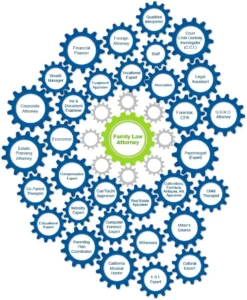
We know that no two divorces are the same, especially when a business is involved. Our divorce lawyers take the time to understand the unique aspects of our Fullerton clients’ cases. By focusing on your goals and concerns, we create a plan that aligns with your priorities. Whether through negotiation or litigation, we’re here to advocate for you at every step.
Business Related Issues In A Divorce: What You Need To Know
Introduction: Understanding the Stakes
Divorce is never fun or easy, and when a small business is involved, it can become one of the most complex and emotionally charged experiences of your life. For business owners in Orange County, understanding how courts value and divide businesses is crucial. Unlike simpler marital assets such as bank accounts or vehicles, businesses bring unique layers of complexity to the divorce process.
This article is designed to help our Fullerton clients by shedding light on how courts handle these issues, provide guidance for working effectively with legal and financial professionals, and explore alternative strategies for navigating your case. By understanding the valuation process and its implications, our Fullerton clients can better protect their interests and make informed decisions throughout the divorce.
What Is The Significance In Business Valuation In An Orange County Divorce?
The importance of a professional business valuation cannot be overstated. Inaccuracies can cost you significantly, potentially resulting in a settlement that is either unfair or unsustainable. Collaborating with a skilled divorce lawyer and forensic accountant can prevent such outcomes.
Consider this:
If you spend $50,000 on professional representation and the court values your business $300,000 less than your spouse demanded, you experienced a sixfold return on your investment (the fees you spent). This example underscores the importance of expert guidance in business cases. While no lawyer can guarantee a specific outcome, the value of thorough preparation and professional representation is often undeniable. The total attorney fees incurred should be calculated after the trial and include the actual fees paid plus any loses at trial attributable to not having a divorce lawyer or a forensic accountant. And the other spouse retains the other community property valued at $100,000.
How Assets Are Divided In An Orange County Divorce
California law requires that community property, the assets acquired during the marriage, be divided equally. However, this doesn’t mean that every individual asset is split 50/50. Instead, the total value of the marital estate is divided equally. Accurate valuations of all assets, including businesses, are critical in achieving a 50/50 division in the overall estate.
Example:
- Business Value: $1,000,000
- Other Community Assets: $100,000
- Total Marital Estate: $1,100,000
So each spouse is entitled to $550,000. If one spouse keeps the business, the spouse who retained the business will owe $450,000 in an equalization payment to the other spouse. Because many small businesses lack liquidity, these payments often involve additional terms, such as interest rates, timelines and collateral security agreements.
On occasion, couples may agree to a “global settlement”. This approach bypasses detailed valuations and focuses instead on dividing assets in a way that feels reasonable and equitable to both parties. While cost effective , this strategy relies heavily on trust and mutual agreement, and clients must knowingly waive their right to an exact 50/50 division.
Are There Any Specific Challenges Valuing A Small Business In An Orange County Divorce?
Valuing a small business introduces complexities that don’t typically arise with most other marital assets. Common challenges include:
- Owner Dependency : The value of many small businesses is tied to the owner’s personal reputation, relationships, or expertise, all of which complicate the valuation.
- Financial Records : Small businesses often lack detailed or professionally maintained financial records, making it more difficult for forensic accountants to prepare an accurate valuation.
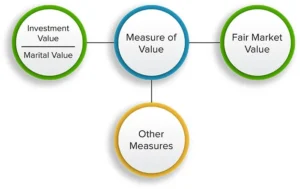
- Investment Value vs. Market Value : Courts typically focus on a business’s “investment value” to the owner, rather than what a third party might pay for it in a sale using the comparable sales method.
To address these issues, courts rely on forensic accountants, who use advanced techniques to provide professional and thorough valuations.
How Do Courts Value Small Businesses In Orange County Divorces?
Orange County courts follow established methods to value businesses in divorce cases. The two most common are:
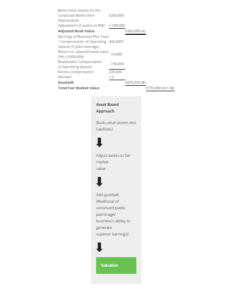
- Capitalization of Excess Earnings : This approach evaluates income exceeding reasonable compensation for the owner, factoring in goodwill, tangible and intangible capital assets are added to the goodwill value to arrive at the total value.
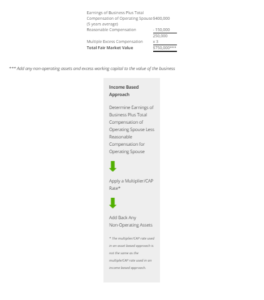
- Capitalization of Earnings : This method analyzes historical earnings to determine the business’s ongoing value.
What Valuation Methods do Courts Avoid?
Speculative valuation methods, such as discounted cash flow (DCF), which projects future earnings, are not allowed in family law. Instead, valuations must be grounded in tangible, historical data and earnings.
What Other Factors Are Relevant In Business Valuation In A Divorce?
- Rules of Thumb : Industry standard “rules of thumb” (e.g. “two times gross sales”) are commonly used outside of divorce proceedings are inadmissible in family law cases due to their lack of evidentiary support or foundation.
- In-Place Value : When goodwill or profitability is minimal or non-existent, courts may assign an “in-place value” to reflect the business’s operational continuity, existing revenue and established infrastructure.
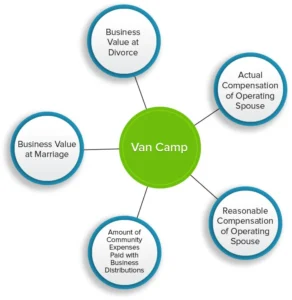
- Post-Separation Growth : In calculating any community right to reimbursement, relative to a spouse’s separate property business, courts may exclude any growth in a business’s value that occurs after the date of separation, attributing the increase to the operating spouse’s separate property business.
What Are Frequently Asked Questions Of People Who Are Involved In A Divorce With A Business Involved?
What Happens if I Owned the Business Before Marriage?
A business owned before marriage is separate property. However, any increase in its value during the marriage may require community reimbursement by the separate property
What if I Don’t Want to Run the Business Any Longer?
If you’re over 65, courts cannot force you to operate a business. However, if you’re younger, they may impute income based on your ability to earn.
What Risks Should Be Considered If Planning On Self-Representation?
While a Fullerton client, representing himself, may seem like a cost-saving option, it often results in costly mistakes, particularly in cases involving businesses. Risks include:
- Not knowing whether an offer is fair or unfair
- Accepting an inaccurate or inflated valuation
- Being unprepared for opposing counsel’s motions, arguments and testimony
- Not knowing the rules of evidence, which may prevent important documents and evidence from being admitted
- Prolonging litigation, which increases costs and stress
What Are The Cost-Effective Representation Alternatives In An Orange County Divorce?
If retaining a divorce lawyer and forensic accountant feels financially prohibitive, there are alternative strategies to consider:
- Mediation: A mediator can facilitate negotiations over business valuations and asset divisions, often at a lower cost than litigation. They do not take sides in the mediation, nor do they protest one party or the other.
- Limited Scope Representation : Hire a divorce lawyer to assist with specific aspects of your case, such as preparing for court or valuing your business, while handling other parts independently.
- Owner-Testified Valuation: California law allows business owners to testify about the value of their business. With guidance from a divorce lawyer or accountant, you can prepare an opinion of value and prepare for the trial.
The Minyard Morris Difference
At Minyard Morris, we pride ourselves on our commitment to providing strategic, efficient, and personalized representation. We’ve spent decades building a reputation for excellence, helping clients navigate the most challenging family law cases with confidence. When a business is involved, our expertise and collaborative approach are invaluable in protecting our clients’ interests and achieving their goals. If results matter, then who you hire is important. Hire the firm that Fullerton has known and trusted for 48 years.
Contact Us Today
If you’re navigating a divorce involving a business, trust Minyard Morris to provide the experience and support you need. Call us at (949)724-1111 or visit our Initial Consultation Page to schedule your consultation.