Buena Park Business Owners Divorce Lawyer

Buena Park Business Owners Divorce Lawyer

Buena Park Business Owners Divorce Attorney

With its proximity to sparkling beaches, Disneyland, and Knott’s Berry Farm, Buena Park is a great place to stay while visiting Southern California. The yearly influx of tourists is also great for local business owners. Even in such a diverse and convenient location, running a business takes hard work and long hours. If your business is threatened by divorce, a Buena Park business owners divorce lawyer will advocate for your goals.

Expert Buena Park Business Owners Divorce Lawyer

Minyard Morris: Your Steadfast Advocate in Business Owners Divorce Cases

When you’ve worked hard to build a successful business, you need to hire a business owners divorce lawyer to protect your assets during a divorce. At Minyard Morris, our team has over 350 years of combined experience in fighting for our clients’ satisfaction. We’ve spent years building relationships with the Orange County courts. Our local knowledge allows us to better serve your goals and interests.

With strong negotiation and litigation skills, we assist you with your divorce proceedings. We believe in a collaborative approach through three weekly strategy meetings to discuss our cases. This approach means that unique aspects of your case are reviewed by our lawyers and at our strategy meetings while you also receive one-on-one attention from your dedicated attorney. We are proud members of the Family Law Section Executive Committee of the California State Bar.

Buena Park Business Owners

In 2024, Buena Park had a total population of 81,248. This included:

  • 45,998 total labor force
  • 34,348 total employees
  • 31% blue collar
  • 68% white collar

There was a total of 3,175 businesses, with a breakdown of:

  • 66% had 1-4 employees
  • 79% had 5-9 employees
  • 28% had 10-19 employees
  • 56% had 20-49 employees
  • 72% had 50 or more employees

Defining Property Types

How your business is handled during a divorce may depend on the type of business it is and it’s character. During the divorce process, all your property and debts are divided based on how they are characterized. California courts recognize several different types of property:

  • Separate property. Assets and debts that were acquired before the marriage began or after the official separation are separate property. Gifts or inheritances acquired during the marriage are generally considered separate property. Separation begins once one spouse expresses a clear desire to get divorced or separate and then takes steps toward that goal.
  • Community property. Assets and debts obtained during the marriage are generally considered community property. Even assets and debts acquired without the other person’s knowledge are considered community property and subject to being divided.
  • Quasi-community property. Assets and debts accumulated during the marriage, but while one or both spouses were living outside California, are considered quasi-community property. The court system treats quasi-community property the same as community property when dividing assets.
  • Commingling property. Some assets and debts acquired before the marriage could be considered part-separate and part community property.

If you agree to a division of assets out of court, you and your spouse can decide how your assets and debts are divided. If the judge determines their distribution, separate property is retained by each spouse, respectively, while community property is divided equally.

Trusted Buena Park Business Owners Divorce Attorney

Valuing a Business During a Divorce

Having a professional valuation of your business is important when submitting the required financial disclosure documents. If the business is valued too low, your spouse may have additional claims to the business, and you may face penalties if the court feels that you intentionally hid the true value. This is why engaging a forensic accountant is often a critical step for ensuring a transparent and defensible valuation.

Before choosing how to determine the value of your business, see determine how the business is characterized. It may be:

  • Community property if it was purchased or started after the marriage began. Even if the business itself is not community property, the income earned during the marriage generally is considered community property.
  • Separate property if the business was purchased or started before the marriage began or after the separation occurred.

A skilled Buena Park business owners divorce attorney will determine which type of property the business is considered. If it is commingled, they can tell what percentage of the business would be deemed either separate or community property.

Having a professional valuation of the business is important to ensure an accurate division of assets. Valuation methods include the following:

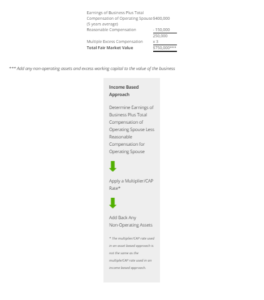
  • The income approach considers past earnings and the profitability of the business. Having a reasonable personal salary provided by the business can also affect asset division.
  • The market approach examines similar businesses in the area that have recently sold. This method theoretically determines the value of the business if it were to be sold.
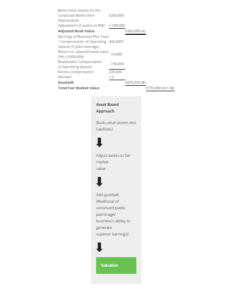
  • The asset approach assesses the total value of all the tangible and intangible assets of the business while considering all debts and liabilities the business might face.

Methods of Dividing Business Assets

Once you have determined the value of the business, you can begin the process of dividing the marital assets equally, per the state’s laws. Several methods may be used to reach a fair agreement, including:

  • Asset offset. You retain the business while your spouse receives different assets of equal value.
  • Buyout. You buy out the value of the business from your spouse so you retain full ownership.
  • Shared ownership. You and your spouse both retain some percentage of ownership in the business.
  • Selling. You sell the business and split the proceeds equally.

The method you choose can have vastly different tax implications, which is a central concern in any high-net-worth divorce involving a business.

Hire a Business Owners Divorce Lawyer

Going through a divorce is rarely simple. With Minyard Morris, you have a team of divorce attorneys who pride themselves on their high levels of professionalism, ethics, and integrity. Our client-centered approach prioritizes your goals. Contact Minyard Morris today for a confidential consultation.
Buena Park Business Owners Divorce Lawyer FAQ

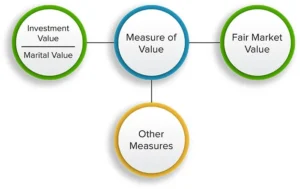
The measure of value can also be a significant issue in a divorce. The divorce court may use going concern value or investment value. The basis for a divorce court using investment value is based on the idea that the business is not being sold, and the value is that of an investment held by the owner himself (IRMO Hewitson). In other words, what is the value of the business to the operator-spouse.

Measure of Value

Methods of Valuation

The expertise and competence of an expert will often have a significant impact on final settlement or trial results. The importance of the role played by an expert in a divorce cannot be over-emphasized. In some divorces, the value of an expert can exceed that of the divorce lawyer. Experts should be retained at the commencement of a divorce, and not after a potential settlement has fallen apart. The expert’s input should be sought before any offers are made or responded to. Early retention of a divorce valuation expert can be critical in the crafting and development of settlement offers, case strategy, and the game plan.

As with Orange County divorce lawyers, all valuation experts are not created equal. It is difficult to quantify the value of the right experts in a divorce. The reputation of an expert is critical to the weight given to an expert by the judge. An unqualified expert may not qualify as an expert in a divorce trial, which would prevent them from testifying. Such a result could be devastating to the outcome of the divorce, as the lawyer would not be able to present evidence of the valuation of the business interest to the divorce court.

One of the theories, Pereira (IRMO Pereira), assigns to the separate property business a reasonable rate of return on the value of the business as it existed on the date of the marriage, and credits the community with the remaining portion of the increase in value. For example, under Pereira, if a business was valued at $1,000,000 on the date of the marriage, and was valued at $2,000,000 ten years later, the community would need to be reimbursed $1,000,000 minus the interest on $1,000,000 for the ten years. Under this approach, there may exist a conflict over what interest rate is applied to the value of the separate property business between the date of marriage and the date of separation, and whether the interest is simple or compound.

Equitable Allocation Approach

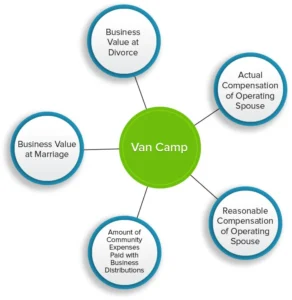
Another approach, Van Camp (IRMO Van Camp), gives the community a right to reimbursement equal to any under-compensation of the owner-spouse during the marriage, and assigns the remainder of any increase in value to the separate property of the owner-spouse.

Any sums paid, during the marriage, by the separate property business to or for the benefit of the community may be deducted from the reimbursement owed by the separate property business to the community for under-compensation under the Van Camp approach. For example, if the separate property business had contributed $1,000,000 to the community during the marriage, over and above the sums paid to the operator-spouse as compensation, and the amount of under-compensation was $1,100,000, the separate property business would be required to reimburse the community $100,000.

The amount owed to the community under either theory is a right to reimbursement and not an interest in the business itself (Patrick v. Alacer Corp. (Patrick I) and Patrick v. Alacer Corp. (Patrick II)).

Application of either of these theories requires a determination of the value of the business on the date of marriage, and on the date of separation.

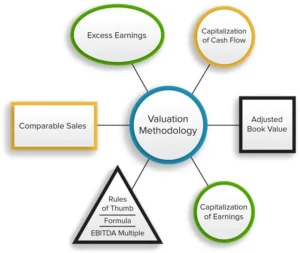
The value may be determined by a number of different formulas, so long as they do not involve speculation, and don’t violate any family law principles. Capitalization of earnings, and capitalization of excess earnings, are the two approaches most often used in Orange County family law matters. A divorce court may also use the market approach for valuation, but the use of this approach presents a number of very significant challenges, including using truly comparable companies for comparison. Rules of thumb approaches are generally not accepted by the Orange County divorce courts, because it is difficult to prove the underlying basis for the rule of thumb formulas (IRMO Honer and IRMO Hewitson). Valuations in Orange County family law cases are quite different than business valuations for other purposes.

A divorce court may also consider prior sales or purchases of interests in the business being valued. This approach can have its own problems, including, that prior sale may utilize the discounted future cash flow method.

In family law, a business cannot be valued using the operating-spouses’ expected future earnings (IRMO Fortier). The widely recognized valuation method referred to as the ‘discounted future cash flow’ method (DCF) is not used in California divorces. The divorce court cannot value a business based on speculation relative to the business’s future success or failure.

Generally, a valuation in a divorce requires an analysis of the business’s financial performance during the past five years. An expert may omit from the average, years or events if they are non-recurring, and if the omission will result in a more accurate view of the normalized financial performance of the business. The five year average may be weighted, depending on the facts and the trends.

Valuation Method: Capitalization of Excess Earnings (Asset Based Approach)

Valuation Method: Capitalization of Earnings (Income Based Approach)

If a capitalization approach is utilized, the excess earnings are multiplied by a ‘multiplier’ or divided by the capitalization rate.

The multiplier/capitalization rate relates directly to the risk of the investment. The riskier the business/industry the lower the multiplier. Consider the case of two businesses, one risky and one secure, each with $50,000 of excess earnings. An investor may only be willing to pay one times earning for the goodwill of the riskier business ($50,000) because the business is less likely to continually return the excess earnings to the investor. Alternatively, an investor may be willing to pay three times earnings for the goodwill of the more secure business ($150,000), because the business is more likely to return those excess earnings to the buyer for an extended period.

Other Factors

As in valuations that are performed in other contexts, collectability of accounts receivable, barriers to entry, management team depth, pending legislation, toxic waste, new competitors, minority discounts, bank covenants and many other issues may be relevant.

There is a presumption that an asset acquired during the marriage is community property. This idea generally applies to the acquisition of a business. However, if a business is acquired prior to the date of the marriage it is the separate property of the owner-spouse.

If the business increases in value during the marriage, the community may be entitled to reimbursement of a portion of that increase. It is clear that the rents, issues, and profits of a separate property asset are the separate property of the owner-spouse. The natural improvement of separate property during the marriage retains its separate property status (IRMO Ney). A change in the form of a business (sole proprietorship to a corporation) does not cause a business to lose its separate property status (IRMO Koester). But, if the increase in value is due, in part, to the effort of a spouse, the community may need reimbursement from the business.

Any reimbursement to the community is based upon the equitable principle that a separate property business is required to repay the community for any uncompensated community effort expended on the separate property business during the marriage. Reimbursement is determined by using one of several different theories or approaches.

In determining the value of a business in a divorce, the court may consider the value of a business that was agreed to in a partnership agreement, but are not bound to value the business interest using that value. The value set forth in such an agreement is not controlling on the divorce court (IRMO Slater).

There are a number of issues that a divorce court looks to in resolving this issue. If a spousal consent was executed, the court will determine whether the agreement was executed by the non-operating spouse with the knowledge that the value being agreed to, would establish a value for the business interest in a future divorce. Whether the non-operating spouse was represented by a lawyer at the time of the execution of the agreement can be critical in the analysis. The terms of the agreement may be binding on the partners/shareholders, but not be binding on the non-operating spouse.

Representing clients in divorce matters involving a business interest usually requires the retention of a number of experts, including a valuation expert, who assists in the negotiations and in reaching a settlement. In many cases, the divorce court will order the accountants to meet and confer long before the divorce trial to attempt to resolve or narrow their differences.

The potential Family Law Team

Experts

If the owner-operator was paid adequate and reasonable compensation during the marriage, there will be no reimbursement to the community under the Van Camp approach. If the owner-operator was under-compensated but the business distributions used for community expenses exceeded the amount of the under-compensation, the community will likewise not be entitled to any reimbursement.Using the Pereira approach, the owner-operator of the separate property business receives an investment rate of return on the value of his or her business as it existed on the date of marriage, and the remaining portion of the increase in value is reimbursed to the community.

Testimonials

HEAR FROM MINYARD MORRIS CLIENTS

Contact Us

SCHEDULE A MINYARD MORRIS CONSULTATION

Contact Minyard Morris now to schedule a consultation with our attorneys and legal professionals.