Fountain Valley Business Owners Divorce Lawyer

Fountain Valley Business Owners Divorce Lawyer

Fountain Valley Business Owners Divorce Attorney

“A Nice Place to Do Business” is the business owner’s motto in Fountain Valley. With ample parks and recreational programs, residents always have access to golf courses, fishing, and a variety of sports fields. Running a business in Fountain Valley is a great choice, but the hazard of losing all or part of that business in a divorce can be devastating. If you’re faced with an impending divorce, contact a Fountain Valley business owners divorce lawyer.

Best Fountain Valley Business Owners Divorce Lawyer

Minyard Morris: Knowledgeable Counsel in Business Owners Divorce Cases

With over 350 years of combined experience, Minyard Morris has built a team with exceptional levels of professionalism, ethics, and integrity. When you need to hire a business owners divorce lawyer, our team of 19 family law attorneys can offer tailored representation that focuses on your unique goals. Divorces are rarely simple, but our firm works to exceed your expectations with our client-focused approach.

Working exclusively in Orange County, we have spent years building strong relationships within the family law courts to better serve our clients. Rated Platinum for Client Service by Martindale Hubbell, we pursue your goals with strategic advice and aggresive advocacy. Three of our lawyers are recipients of the Best Lawyers in America Orange County Family Lawyer of the Year. We are frequent collaborators on many family law topics.

Fountain Valley Business Owners

In 2024, Fountain Valley had a total population of 54,678, including:

  • 28,694 total labor force
  • 29,407 total employees
  • 27% blue collar
  • 72% white collar

Fountain Valley had a total of 3,322 businesses, with a breakdown of:

  • 26% had 1-4 employees.
  • 92% had 5-9 employees.
  • 89% had 10-19 employees.
  • 71% had 20-49 employees.
  • 25% had 50 or more employees.

Property Classifications During Divorce

As a business owner navigating divorce, how your business assets are divided depends on how the property is characterized. During the divorce, all your assets and debts should be divided, either informally through a private agreement or formally through the court system.

In California, the family law courts generally divide property into four categories:

  1. Community property includes assets and debts acquired during the marriage up to the date of separation.
  2. Separate property encompasses the assets and debts acquired before the marriage began or after the legal date of separation. The date of separation is considered the date either spouse expresses a clear desire to divorce and then follows through with that intent. Gifts and inheritances obtained during the marriage are generally also considered separate property.
  3. Quasi-community property includes assets and debts accumulated during the marriage but not within California. California treats these items as community property during division.
  4. Commingled property includes assets acquired through a comingling of separate and community property. These items are typically high-value assets, such as properties or accounts opened before the marriage that have remained open during it.

In the California divorce process, each spouse retains their separate property, and the community property is divided equally. If you and your spouse decide on a fair distribution of the community property, the judge will approve of it, even if it is not divided equally.

Trusted Fountain Valley Business Owners Divorce Attorney

Business Valuation During a Divorce

A business owners divorce lawyer knows how to determine the characterization of your business, per California’s business owners divorce laws. The character of property the business is may determine how it can be handled during the divorce process:

  • Community property. The business is considered jointly owned if it was acquired during the marriage. The income earned from the business during the marriage is also considered a marital asset, separate from the business itself.
  • Separate property. The business is deemed separate property if it was acquired before the beginning of the marriage or after the date of separation.

During the divorce process, you have to provide a financial disclosure, which lists all your financial information, to your spouse. This financial disclosure must include a fair valuation of your business based on an acceptable appraisal method. Valuation methods include:

  • Income approach. This considers the projected earnings and profitability of the business. Establishing that you are paid a reasonable salary from the business can also influence any spousal claims made against the business.
  • Market approach. This approach examines similar businesses in the area that have recently been sold. If the business is unique, this method may not provide as accurate a value.
  • Asset approach. This assesses the total value of the business by valuing tangible and intangible assets while also factoring in liabilities.

You are not limited to one method of valuation. A skilled Fountain Valley business owners divorce attorney can make sure a professional valuation is conducted, as this can provide an accurate assessment of the current and future value of your business. In many cases, this involves working with a forensic accountant to ensure the valuation is comprehensive and withstands legal scrutiny. An inaccurate valuation will affect how the assets are divided.

Dividing Business Assets

Once the valuation is determined, attention must be given to determining you can decide which method to use for dividing your business assets. Possible methods include:

  • Buyout. You can purchase your spouse’s stake in the business to retain sole ownership.
  • Asset offset. You can offer assets of equal value in exchange for sole ownership of the business.
  • Shared ownership. You and your spouse both retain ownership of the business after the divorce.
  • Selling. The business can be sold, and the proceeds are divided among the other assets. A critical factor in choosing a division method is understanding the distinct tax consequences each option carries.

Hire a Business Owners Divorce Lawyer

At Minyard Morris, we believe that collaboration builds strong cases. Our divorce attorneys meet weekly to discuss strategies and the unique circumstances of our clients’ cases. That way, we approach each situation as effectively as possible. Contact Minyard Morris to arrange a confidential consultation.
Fountain Valley Business Owners Divorce Lawyer FAQ

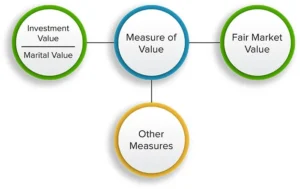
The measure of value can also be a significant issue in a divorce. The divorce court may use going concern value or investment value. The basis for a divorce court using investment value is based on the idea that the business is not being sold, and the value is that of an investment held by the owner himself (IRMO Hewitson). In other words, what is the value of the business to the operator-spouse.

Measure of Value

Methods of Valuation

The expertise and competence of an expert will often have a significant impact on final settlement or trial results. The importance of the role played by an expert in a divorce cannot be over-emphasized. In some divorces, the value of an expert can exceed that of the divorce lawyer. Experts should be retained at the commencement of a divorce, and not after a potential settlement has fallen apart. The expert’s input should be sought before any offers are made or responded to. Early retention of a divorce valuation expert can be critical in the crafting and development of settlement offers, case strategy, and the game plan.

As with Orange County divorce lawyers, all valuation experts are not created equal. It is difficult to quantify the value of the right experts in a divorce. The reputation of an expert is critical to the weight given to an expert by the judge. An unqualified expert may not qualify as an expert in a divorce trial, which would prevent them from testifying. Such a result could be devastating to the outcome of the divorce, as the lawyer would not be able to present evidence of the valuation of the business interest to the divorce court.

One of the theories, Pereira (IRMO Pereira), assigns to the separate property business a reasonable rate of return on the value of the business as it existed on the date of the marriage, and credits the community with the remaining portion of the increase in value. For example, under Pereira, if a business was valued at $1,000,000 on the date of the marriage, and was valued at $2,000,000 ten years later, the community would need to be reimbursed $1,000,000 minus the interest on $1,000,000 for the ten years. Under this approach, there may exist a conflict over what interest rate is applied to the value of the separate property business between the date of marriage and the date of separation, and whether the interest is simple or compound.

Equitable Allocation Approach

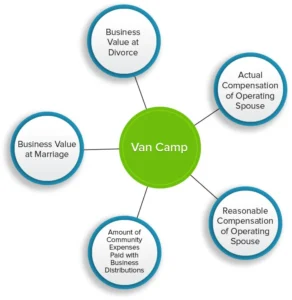
Another approach, Van Camp (IRMO Van Camp), gives the community a right to reimbursement equal to any under-compensation of the owner-spouse during the marriage, and assigns the remainder of any increase in value to the separate property of the owner-spouse.

Any sums paid, during the marriage, by the separate property business to or for the benefit of the community may be deducted from the reimbursement owed by the separate property business to the community for under-compensation under the Van Camp approach. For example, if the separate property business had contributed $1,000,000 to the community during the marriage, over and above the sums paid to the operator-spouse as compensation, and the amount of under-compensation was $1,100,000, the separate property business would be required to reimburse the community $100,000.

The amount owed to the community under either theory is a right to reimbursement and not an interest in the business itself (Patrick v. Alacer Corp. (Patrick I) and Patrick v. Alacer Corp. (Patrick II)).

Application of either of these theories requires a determination of the value of the business on the date of marriage, and on the date of separation.

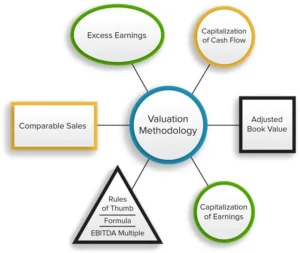
The value may be determined by a number of different formulas, so long as they do not involve speculation, and don’t violate any family law principles. Capitalization of earnings, and capitalization of excess earnings, are the two approaches most often used in Orange County family law matters. A divorce court may also use the market approach for valuation, but the use of this approach presents a number of very significant challenges, including using truly comparable companies for comparison. Rules of thumb approaches are generally not accepted by the Orange County divorce courts, because it is difficult to prove the underlying basis for the rule of thumb formulas (IRMO Honer and IRMO Hewitson). Valuations in Orange County family law cases are quite different than business valuations for other purposes.

A divorce court may also consider prior sales or purchases of interests in the business being valued. This approach can have its own problems, including, that prior sale may utilize the discounted future cash flow method.

In family law, a business cannot be valued using the operating-spouses’ expected future earnings (IRMO Fortier). The widely recognized valuation method referred to as the ‘discounted future cash flow’ method (DCF) is not used in California divorces. The divorce court cannot value a business based on speculation relative to the business’s future success or failure.

Generally, a valuation in a divorce requires an analysis of the business’s financial performance during the past five years. An expert may omit from the average, years or events if they are non-recurring, and if the omission will result in a more accurate view of the normalized financial performance of the business. The five year average may be weighted, depending on the facts and the trends.

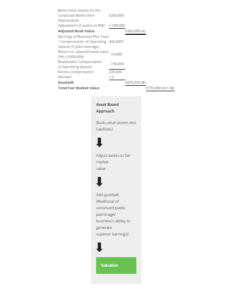
Valuation Method: Capitalization of Excess Earnings (Asset Based Approach)

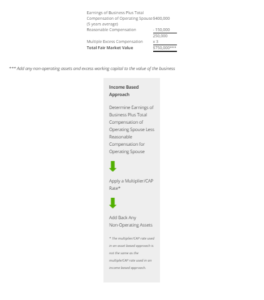
Valuation Method: Capitalization of Earnings (Income Based Approach)

If a capitalization approach is utilized, the excess earnings are multiplied by a ‘multiplier’ or divided by the capitalization rate.

The multiplier/capitalization rate relates directly to the risk of the investment. The riskier the business/industry the lower the multiplier. Consider the case of two businesses, one risky and one secure, each with $50,000 of excess earnings. An investor may only be willing to pay one times earning for the goodwill of the riskier business ($50,000) because the business is less likely to continually return the excess earnings to the investor. Alternatively, an investor may be willing to pay three times earnings for the goodwill of the more secure business ($150,000), because the business is more likely to return those excess earnings to the buyer for an extended period.

Other Factors

As in valuations that are performed in other contexts, collectability of accounts receivable, barriers to entry, management team depth, pending legislation, toxic waste, new competitors, minority discounts, bank covenants and many other issues may be relevant.

There is a presumption that an asset acquired during the marriage is community property. This idea generally applies to the acquisition of a business. However, if a business is acquired prior to the date of the marriage it is the separate property of the owner-spouse.

If the business increases in value during the marriage, the community may be entitled to reimbursement of a portion of that increase. It is clear that the rents, issues, and profits of a separate property asset are the separate property of the owner-spouse. The natural improvement of separate property during the marriage retains its separate property status (IRMO Ney). A change in the form of a business (sole proprietorship to a corporation) does not cause a business to lose its separate property status (IRMO Koester). But, if the increase in value is due, in part, to the effort of a spouse, the community may need reimbursement from the business.

Any reimbursement to the community is based upon the equitable principle that a separate property business is required to repay the community for any uncompensated community effort expended on the separate property business during the marriage. Reimbursement is determined by using one of several different theories or approaches.

In determining the value of a business in a divorce, the court may consider the value of a business that was agreed to in a partnership agreement, but are not bound to value the business interest using that value. The value set forth in such an agreement is not controlling on the divorce court (IRMO Slater).

There are a number of issues that a divorce court looks to in resolving this issue. If a spousal consent was executed, the court will determine whether the agreement was executed by the non-operating spouse with the knowledge that the value being agreed to, would establish a value for the business interest in a future divorce. Whether the non-operating spouse was represented by a lawyer at the time of the execution of the agreement can be critical in the analysis. The terms of the agreement may be binding on the partners/shareholders, but not be binding on the non-operating spouse.

Representing clients in divorce matters involving a business interest usually requires the retention of a number of experts, including a valuation expert, who assists in the negotiations and in reaching a settlement. In many cases, the divorce court will order the accountants to meet and confer long before the divorce trial to attempt to resolve or narrow their differences.

The potential Family Law Team

Experts

If the owner-operator was paid adequate and reasonable compensation during the marriage, there will be no reimbursement to the community under the Van Camp approach. If the owner-operator was under-compensated but the business distributions used for community expenses exceeded the amount of the under-compensation, the community will likewise not be entitled to any reimbursement.Using the Pereira approach, the owner-operator of the separate property business receives an investment rate of return on the value of his or her business as it existed on the date of marriage, and the remaining portion of the increase in value is reimbursed to the community.

Testimonials

HEAR FROM MINYARD MORRIS CLIENTS

Contact Us

SCHEDULE A MINYARD MORRIS CONSULTATION

Contact Minyard Morris now to schedule a consultation with our attorneys and legal professionals.