California couples facing divorce often question whether spousal support (also referred to as alimony) will be a factor in their case. The 20 Orange County divorce attorneys at Minyard Morris are prepared to analyze your situation and advise you regarding the likelihood of one side or the other receiving an award for spousal support, whether temporarily or permanently. An Orange County spousal support lawyer can manage your case so you achieve your goals.

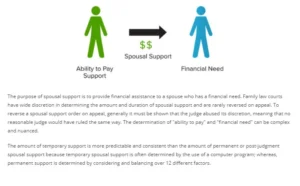
The Orange County family law court may order one party to pay spousal support to the other based upon an analysis of one party’s ability to pay and the other party’s needs. Spousal support payable before the court enters a final divorce judgment is characterized as temporary support. The court may also make an award for permanent spousal support in the judgment.
Hire a Spousal Support Lawyer Backed by Decades of Experience
For decades, Minyard Morris has provided spouses in Orange County with exceptional legal services that helped them manage their alimony cases with confidence. Our award-winning alimony attorneys understand the complexities of alimony cases, Orange County spousal support laws, and how to secure favorable outcomes for our clients.
Every week, we gather for firm wide strategy sessions where we use our collective 350-plus years of legal experience to problem-solve cases for our clients. When you partner with our award-winning law firm, you gain insight and support from a team that has a strong record of delivering favorable outcomes for the people we represent.
Considerations in Spousal Support Determination
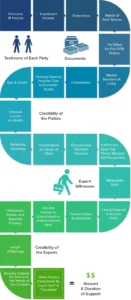
When considering spousal support, the family law judge will likely require a clear need by one spouse and a clear ability to pay by the other spouse. The determination of the amount and duration of the spousal support order is based on many factors. These factors include:
- Income from employment and investments
- Deductions
- Marital standard of living
- Age and health of both spouses
- Terms of any prenuptial agreement
- Career, education, skills and potential income of both spouses
- Length of the marriage (marriages under 10 years are assessed differently relative to duration than longer marriages)
- Whether there is a history of domestic violence during the marriage
- Other factors set out in Family Code §4320
Orange County family law courts have wide discretion when it comes to determining the amount of spousal support in Orange County. The objective of temporary spousal support is to maintain the financial status quo of the parties to the extent possible, whereas permanent support is based on the factors listed above. Permanent support may be modified in the future if there is a change in circumstances. Permanent support does not mean that the support will be paid for an indefinite period of time.
At Minyard Morris , we use our decades of experience to quickly and efficiently gather the facts necessary to see the big picture of your case and the relevant facts. We use those facts to develop a strategic approach to protecting your financial best interest.
Modification of Spousal Support Orders
Either you or your former spouse can request that the court modify spousal support based on changes in income or other circumstances. At Minyard Morris , we understand the law and life’s changes. If you’re considering changes, it’s important to understand when and how to modify spousal support in California.
Are Temporary Spousal Support Orders Modifiable?
Divorce case law states that there must be a change in circumstances to modify a temporary spousal support order. However, as a practical matter, most divorce courts require a change in circumstances before modifying a temporary order. Spousal support can be modified retroactively only to the date of the filing and service of a Request For Order seeking to modify the support.
Are All Permanent Spousal Support Orders Modifiable?
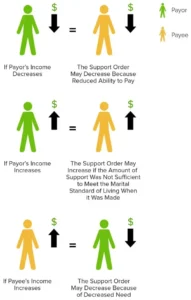
A permanent spousal support order may be modified by the divorce court upward or downward if there has been a change in circumstances (IRMO Clements). We can help you determine if your situation may warrant modification by the court. The family law court does not have jurisdiction to modify non-modifiable orders. Spousal support modification after divorce may be necessary when circumstances significantly change post-judgment.
Spousal Support in High-Net-Worth Divorces
High-net-worth divorces often involve complicated financial questions that go beyond typical support calculations. Judges consider multiple income sources, such as business revenue, investment returns, and deferred compensation, along with other sources of income.
When the divorce involves a significant income, the courts rely on other factors like the lifestyle of the spouses and their earning ability in determining permanent spousal support. Continuity is one factor that can influence spousal support; the judge may consider whether the divorcing spouse can continue to maintain their current living standard on their own. For long marriages, this can be especially important as a consideration.
The Role of Domestic Violence in Spousal Support Decisions
Domestic violence can have a direct impact on spousal support eligibility in California. If a spouse has been convicted of abuse within five years of divorce filings, the court may deny their request for support entirely.
In other cases, the abuse may influence the judge’s assessment of emotional hardship, future employability, or the victim’s need for financial support. Judges consider factors like safety, fairness, and the lasting impact of abuse when determining whether an award is appropriate.
How Child Support and Spousal Support Intersect
Although child support and spousal support serve different functions, they often arise together in divorce proceedings. Child support is intended to meet the needs of the child, while spousal support addresses a financial imbalance between the parties. However, both forms of support are influenced by many of the same factors, especially income and the division of parenting time.
Courts must weigh the financial circumstances of each party to make sure support orders are fair and workable. A well-prepared legal strategy will clarify each party’s obligations, thereby preventing excessive financial strain while adequately supporting both children and former spouses.
Spousal Support Statistics and Related News
Celebrity divorces may seem distant from everyday life. They offer a window into the court dynamics that often lead to spousal support orders in California.
In July 2025, news broke that Aaron Phypers filed for divorce from actress Denise Richards. He then requested spousal support and a split of their business assets. He had “no income since” closing his wellness company in 2024. He claims Richards earns around $250,000 a month from OnlyFans and brand deals.
According to Reuters, only about 3% of the roughly 400,000 alimony recipients are male, based on the most recent credible data available. In California, the divorce rate in 2022 was 17.77 per 1,000 married women.
Child support continues to be a common issue in California. The Orange County Child Support Services annual report for FY 2023–24 recorded 6,340 new cases opened during the federal fiscal year. Families who face support disputes in areas like Irvine, Newport Beach, or Santa Ana typically resolve matters at the Lamoreaux Justice Center in Orange and the Central Justice Center in Santa Ana.
Discuss Your Modification Questions with Us

We are here to answer your questions and assist you in making a strategic decision regarding the modification of a spousal support order. Schedule an appointment by calling our office in Newport Beach at 949-724-1111 or filling out our online contact form.
Difference Between Temporary and Permanent Spousal Support
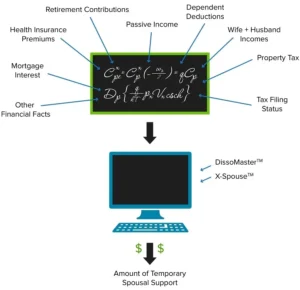
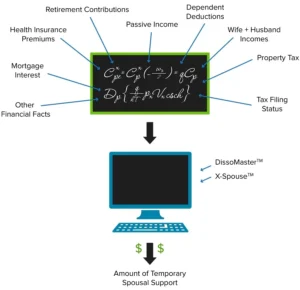
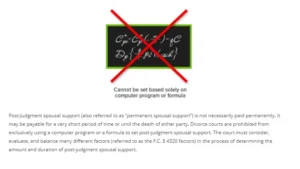
Spousal support paid prior to the entry of the Judgment is characterized as temporary spousal support or pendent lite spousal support. Temporary spousal support may be ordered at a Request For Order (RFO) and is designed to maintain the status quo of the parties, where possible. The amount of temporary spousal support is often determined with the utilization of a formula accessed through the use of a computer software program (DissoMaster or X-Spouse).
Temporary spousal support may be ordered retroactively to the filing date of the Request for Order (RFO) seeking spousal support. Generally, the payor-spouse is credited with payments made to the payee-spouse or paid for that spouse’s benefit. However, a spousal support order at the trial may not be made retroactive to the date of the Petition unless a spouse had previously requested temporary spousal support (Mendoza v. Cuellar). A family law court may order temporary spousal support pending the determination of issues involved in an Out-of-State divorce (Gromeeko v. Gromeeko).
What is Permanent Spousal Support?
At the divorce trial, permanent spousal support may be ordered. The term “permanent” is misleading because permanent spousal support may be ordered for a limited period of time. The term permanent is intended to distinguish this spousal support from temporary spousal support. This spousal support is also referred to as post-judgment or long-term spousal support.
Income and Spousal Support
The primary factor used by the divorce court to determine the amount of spousal support is income. The definition of income is the subject of statutory law and many cases interpreting the statutes. Income available for spousal support and child support may be defined by the divorce court differently.
How is a Lump-Sum Severance Payment Treated Relative to Spousal Support?
Lump-sum severance compensation is to be spread out over the term of employment for which it is being paid, and not allocated to the month in which it is received (IRMO Tong and Samson).
Contact Our Orange County Alimony Lawyers Today
High-net-worth divorce cases require careful handling of complex financial matters, from business valuations to real estate holdings to investment portfolios. Every decision has long-term implications, especially when significant assets are at stake. Whether your case involves separate property disputes or high-value spousal support, having a focused, assertive attorney is essential for securing a favorable outcome.
At Minyard Morris, you receive more than individual representation. You gain the insight of a team with over 350 years of combined legal experience. We hold firmwide weekly strategy meetings, bringing creativity, precision, and depth to every case. Call 949-724-1111 to speak with a member of the Minyard Morris team. You can also reach us via email. Our website also provides information regarding how to prepare for our initial meeting and how to manage and minimize attorney fees.