Anaheim Hills Divorce Attorneys for Seniors

Anaheim Hills Divorce Attorneys for Seniors

When you’re a senior facing divorce in Anaheim Hills, finding the appropriate attorney to handle your unique needs is crucial. At this stage in your life, it’s essential to choose established experts in any professional field, particularly when it concerns family law.

Minyard Morris boasts a team of 20 attorneys specializing exclusively in family law, with a collective experience nearing 350 years. Our practice is dedicated solely to family law cases in Orange County, a focus we’ve maintained for over four decades. Our firm’s growth to become the largest in the county for family law is a result of our outstanding client outcomes and exceptional service. We have been serving the residents of Anaheim Hills since 1976. As a matter of fact, founding partner Mark Minyard and his family called Anaheim Hills home for many years.

Divorce proceedings for Anaheim Hills seniors can involve unique considerations compared to those of younger couples. These might include the handling of retirement plans already in distribution, changes in income due to the end of active employment, or adjustments to living arrangements like business sales or home downsizing.

Why Minyard Morris?

Can smaller firms with fewer years of experience match the capabilities of a larger, more seasoned firm like ours? A thorough comparison of different attorneys’ websites will make this decision straightforward. Minyard Morris combines the resources necessary for handling any legal challenge with the personalized attention each Anaheim Hills client deserves. In 2024, the preeminent independent lawyer rating service BEST LAWYERS IN AMERICA listed 19 of 20 Minyard Morris attorneys. So we also have the recognition to back up our vast experience.

Legal Questions for Seniors Who Divorce

Seniors contemplating divorce face specific legal questions, such as:

  • Social Security Benefits: A spouse is not entitled to half of your Social Security payments but may receive derivative benefits that don’t impact your own payments. These benefits are considered when calculating spousal support.
  • Spousal Support and Age: There is no automatic cessation of spousal support at age 65. It’s determined by income, not age, but a court won’t impute income for a spouse beyond this age.
  • Continuation of Spousal Support Post-Retirement: Spousal support can continue if the retired individual still receives income from investments and retirement plans.

Are You a Senior Considering Divorce? Call Our Anaheim Hills Family Law Firm

When you have a need to consult with a family law attorney, contact the Orange County firm of Minyard Morris. Allow us to assist you during this challenging time as your family law attorney and your trusted advisor. Call us at 949-724-1111 or contact us online to learn how we can guide you to a favorable resolution.
Anaheim Hills Family Law Practice Areas:

Anaheim Hills Divorce Attorneys for Seniors FAQ

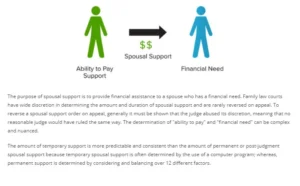
If there is a demonstrated need by one spouse, and a demonstrated ability to pay relative to the other spouse, a divorce court will likely make an order for spousal support payable to the spouse in need. The determination of the amount, duration, and other terms of the spousal support order can be very complex.

Spousal Support

Free rent and meal allowances may be income. Deferred salary is income, as are recurring payments from family members (gifts) that are not loans or early inheritance. Unallocated, lump-sum, personal injury recovery, or annuity, payments are generally not characterized as income. Student loans and unrealized gain in shares of stock are not income. The proceeds received from the sale of stock that were reinvested are not income available for support.

A family law court may order one party to pay spousal support to the other, if that party has the need and the payor has the ability to pay. Spousal support payable before the judgment is entered is called temporary support, and spousal support paid after the judgment is called permanent spousal support.

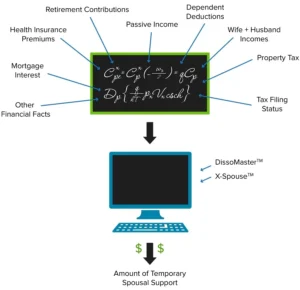
Spousal support paid prior to the entry of the Judgment is characterized as temporary spousal support or pendent lite spousal support. Temporary spousal support may be ordered at a Request For Order (RFO) and is designed to maintain the status quo of the parties, where possible. The amount of temporary spousal support is often determined with the utilization of a formula accessed through the use of a computer software program (DissoMaster or X-Spouse).

Temporary spousal support may be ordered retroactively to the filing date of the Request for Order (RFO) seeking spousal support. Generally, the payor-spouse is credited with payments made to the payee-spouse or paid for that spouse’s benefit. However, a spousal support order at the trial may not be made retroactive to the date of the Petition unless a spouse had previously requested temporary spousal support (Mendoza v. Cuellar). A family law court may order temporary spousal support pending the determination of issues involved in an Out-of-State divorce (Gromeeko v. Gromeeko).

Temporary Spousal Support

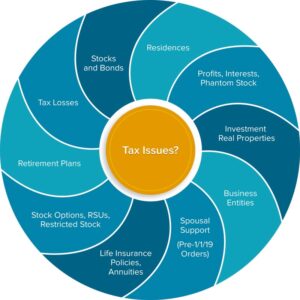
Tax Issues

At the divorce trial, permanent spousal support may be ordered. The term “permanent” is misleading because permanent spousal support may be ordered for a limited period of time. The term permanent is intended to distinguish this spousal support from temporary spousal support. This spousal support is also referred to as post-judgment or long-term spousal support.

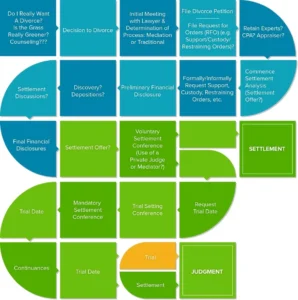
Potential Sequence of Steps and Procedural Events in a Divorce

Spousal Support Retroactivity

A court is to look to all circumstances when determining whether to extend spousal support (IRMO Wilson).There are many circumstances that may justify a modification of a permanent spousal support including the following:

  1. Decrease in income of the payor-spouse;
  2. Increase in income of the payee-spouse;
  3. End of child support;
  4. Discharge by payee-spouse of all community debts assigned to payee (IRMO Clements);
  5. Unrealized expectations that payee-spouse would be self-supporting (IRMO Beaust);
  6. Payee’s support of adult children (IRMO Serna);
  7. Cohabitation and romantic relationship;
  8. Increase in child support (IRMO McCann);
  9. Payor-spouse’s 65th birthday and retirement (IRMO Reynolds).

The following may not constitute a change of circumstances:

  • Payee-spouse paying expenses of daughter and two grandchildren (IRMO Serna);
  • Ability to access retirement funds without penalty (IRMO Dietz);
  • Generally, mere passage of time;
  • Increased income by payor-spouse without a showing by the payee-spouse that the original award failed to meet the marital standard of living;
  • Payee-spouse’s pursuit of an advanced degree as opposed to obtaining a job; and
  • Payee-spouse’s continued disability in a short-term marriage.

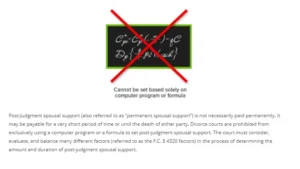
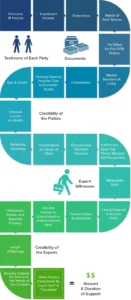
The award of permanent spousal support is based on the factors set forth in Family Code § 4320 as opposed to being based on the “status quo” as is the standard for temporary support matters. The divorce court cannot set permanent spousal support exclusively using the computer software formula used in setting temporary spousal support. Family Code § 4320 sets forth specific factors that the divorce court must consider:

a. The extent to which the earning capacity of each party is sufficient to maintain the standard of living established during the marriage, taking into account all of the following:

1. The marketable skills of the supported party; the job market for those skills; the time and expenses required for the supported party to acquire those skills; and the possible need for retraining or education to acquire other, more marketable skills or employment.

2. The extent to which the supported party’s present or future earning capacity is impaired by periods of unemployment that were incurred during the marriage to permit the supported party to devote time to domestic duties.

Permanent Support

b. The extent to which the supported party contributed to the attainment of an education, training, a career position, or a license by the supporting party.

c. The ability of the supporting party to pay spousal support, taking into account the supporting party’s earning capacity, earned and unearned income, assets, and standard of living.

d. The needs of each party based on the standard of living established during the marriage.

e. The obligations and assets, including the separate property, of each party.

f. The duration of the marriage.

g. The ability of the supported party to engage in gainful employment without unduly interfering with the interests of dependent children in the custody of the party.

h. The age and health of the parties.

i. Documented evidence, including a plea of nolo contendere, of any history of domestic violence, as defined in Section 6211, between the parties or perpetrated by either party against either party’s child, including, but not limited to, consideration of emotional distress resulting from domestic violence perpetrated against the supported party by the supporting party, and consideration of any history of violence against the supporting party by the supported party.

j. The immediate and specific tax consequences to each party.

k. The balance of the hardships to each party.

l. The goal that the supported party shall be self-supporting within a reasonable period of time. Except in the case of a marriage of long duration as described in Section 4336, a “reasonable period of time” for purposes of this section generally shall be one-half the length of the marriage. However, nothing in this section is intended to limit the court’s discretion to order support for a greater or lesser length of time, based on any of the other factors listed in this section, Section 4336, and the circumstances of the parties.

m. The criminal conviction of an abusive spouse shall be considered in making a reduction or elimination of a spousal support award in accordance with Section 4324.5 or 4325.

n. Any other factors the court determines are just and equitable.

F.C. § 4320 Factors

The marital standard of living is relevant to the determination of spousal support. However, it is just one of the Family Code Section 4320 factors (IRMO Smith / IRMO Zywiciel). It is neither a ceiling nor a floor for the amount of spousal support. The marital standard of living may be looked at by the divorce court as a benchmark. The divorce court may define the marital standard of living specifically with a dollar level or generally in terms like “middle class standard of living” (IRMO Kerr).

The divorce court must consider the marital standard of living of both parties, not just that of the payee spouse (IRMO Andreen).

Testimonials

HEAR FROM MINYARD MORRIS CLIENTS

Contact Us

SCHEDULE A MINYARD MORRIS CONSULTATION

Contact Minyard Morris now to schedule a consultation with our attorneys and legal professionals.