Brea Child Custody Lawyer

Brea Child Custody Lawyer

The outcome of a child custody case determines when and how often you can see your child until they reach adulthood. Given the long-term consequences of a custody case, many parents are understandably anxious about these types of cases. A skilled Brea child custody lawyer can provide reassurance and legal guidance during this process, ensuring that your rights are protected and your interests are carefully considered by the family courts.

hire best brea child custody lawyer

A Family Law Firm Dedicated to Delivering Exceptional Legal Services

“The legal services at Minyard Morris go beyond providing standard legal services. We believe in delivering positive results to our clients with exceptional strategic planning and results. To achieve our goals, our entire team of family law attorneys meets three times a week to conduct strategy meetings where our lawyers problem-solve and use their collective experience to work through specific challenges faced by our clients.”

This unique approach sets our law firm apart from the competition. Family law cases can be incredibly complex, which is why we take this collective approach to ensure that we exceed the expectations of our clients. If you have concerns about the potential outcomes of a pending child custody case, trust Minyard Morris to protect your rights and further your interests in court.

Legal Versus Child Custody

During your child custody case, the courts will establish your custody rights. These court-enforceable rights determine where your child lives, how often they see you, and whether you have the authority to determine where they go to school, and which doctor they see when they are sick.

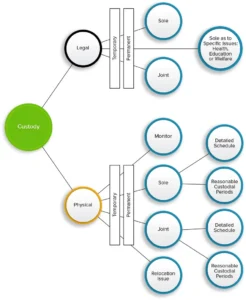
Decision-making rights are determined by legal custody. Parents can have joint legal custody over a child, or one parent can have primary legal custody over the child. Physical custody determines where the child lives. If both parents share physical custody, the child may effectively have two homes. In cases where both parents are found to be fit, the courts generally award some type of joint custody arrangement. An experienced lawyer can guide you through high-conflict child custody cases helping you understand your rights and work toward a fair resolution.

Establishing Visitation Schedules

Establishing custody orders is one important component of a custody case, but the visitation schedule can be equally important for parents seeking meaningful time with their children post-divorce. The visitation schedule details which vacations the child spends with either parent in a given year. Weekend visits are planned out until the child turns 18.

Visitation schedules allow both parents to plan for the future while remaining on the same page when it comes to custody agreements. Once signed by a judge, the orders are court-enforceable, and any party who violates the terms of the order can face serious penalties.

The Role of Legal Representation During a Custody Case

Family law attorneys in Brea, California play a crucial role in protecting your time with your children after a divorce. They carefully review court filings from the other party to anticipate and counter any legal strategies that could impact your case.

If you face false accusations of abuse or neglect, an attorney can respond quickly to prevent these claims from affecting your custody rights. They also offer strategic support throughout the legal process, working to protect your parental rights and ensure fair child custody and visitation orders that prioritize your child’s well-being.

Child Custody Modifications

Modifications to existing custody arrangements are sometimes necessary. When one parent moves farther away, that geographic shift can make the current parenting schedule untenable. In other cases, one parent may fail to exercise their visitation rights, which can mean that they lose scheduled visitation time following a modification.

The courts generally want to see that a substantial change has occurred in the living circumstances of at least one child. If one parent takes on greater parenting responsibilities, they may be entitled to see additional financial compensation from the other parent.

FAQs

Can One Parent Lose Custody Rights?

Yes. A parent can lose parental rights for multiple reasons. Abuse, neglect, and abandonment are common reasons why one parent may have their custody rights reduced. Failure to exercise visitation rights is another possible reason why a judge may reallocate custody rights in favor of the more stable and present parent. Even when a parent has been accused of being unfit, they still have the right to seek legal representation to protect their rights.

Can a Mother Legally Prevent a Father From Seeing a Child in California?

A mother cannot indefinitely prevent a father from seeing a child in California, especially when the father takes decisive action by hiring a family law attorney to protect his rights. Without an enforceable court order, law enforcement is likely to consider a custody disagreement a domestic matter and not get involved. By obtaining and enforcing a court order that guarantees the father’s visitation and custody rights, we can ensure that the father’s rights are not violated by the mother.

What Are the Potential Drawbacks of 50/50 Custody?

While 50/50 custody allows both parents equal time with their child, it can present some challenges. If parents live far apart, the travel considerations can become time-consuming and costly. If one parent struggles financially or works long or unconventional hours, finding supervision for the child can be difficult. While 50/50 custody may come with benefits in many situations, not every family situation is ideal for equally shared parenting.

Does California Favor Joint Custody?

California courts encourage joint custody agreements when both parents are involved and active in their child’s lives. Children benefit from having meaningful time with both parents. The only exception to this preference for joint custody is when one parent has a history of abuse or neglect. In those cases, sole custody may be the ideal arrangement for protecting the child’s safety and well-being.

Get a Legal Consultation for Child Custody Cases with Minyard Morris

Child custody plays an important role in guiding the growth and development of your child. By working with an experienced family law firm, you can ensure that the courts prioritize your child’s interests. The attorneys at Minyard Morris take a strategic approach to every case we work on, ensuring our client’s parental rights are protected throughout their child custody case.

We understand how critically important your time with your child is, and we proactively manage your case to ensure a favorable outcome that protects those rights. Contact our office today to schedule your child custody consultation today.

Brea Child Custody Lawyer FAQ

A client should expect their divorce lawyer to be beyond candid, and explain to them the strengths and weaknesses of the case, and the probable outcome of litigation at the first attorney-client meeting and at every stage during the process, as new facts unfold. A client should have the opportunity to make informed and timely decisions about their children. Our Orange County divorce lawyers are known for telling our clients the good, the bad, and the ugly about child custody matters – early and often. Clients deserve to hear the truth, not a sales pitch.

The parties may agree to resolve their differences in child custody and child visitation matters. If the parties reach an agreement, they are not required to attend a court mandated child custody mediation. The Orange County divorce court will sign a child custody stipulation, and rarely questions the parents’ decisions in these matters.

If the divorce court is asked to make orders relative to child custody, it will make the determination based on the best interests of the child unless the hearing is the modification of a “final” order (Montenegro v. Diaz) and in that case, the test will be whether there has been a “substantial change of circumstances.” (Burchard v. Garay)

The divorce court considers many different factors in determining “best interests” or “change of circumstances.” These two concepts are somewhat vague and subject to interpretation. Results of child custody litigation are not overly predictable by divorce lawyers. Different Judges may rule different ways on the same set of facts. Divorce courts have wide discretion in child custody litigation and reversing a divorce court’s child custody order on appeal is rare given the high degree of discretion.

The parties may not contract with each other or stipulate as to a particular standard of review relative to future child custody orders and the divorce court would not be bound by such stipulations. In Marriage of Cohen, the court ruled that parties could not bind the court relative to child support orders and the same rule would apply to child custody orders. (IRMO Cohen)

Best Interests of Child

Before any contested child custody matter may be presented in a divorce court, the parties must attend court mandated child custody mediation. If one of the parties fails to attend the child custody mediation, the custody consequences may be sanctions and/or a delay in the proceedings. In Orange County, child custody mediation is confidential and the results of the child custody mediation are not reported to the judge unless a child custody agreement is reached. The rules are different in other counties.

Divorce lawyers do not accompany the parties in the child custody mediation sessions.

It is important to speak with an Orange County divorce lawyer prior to the child custody mediation in order to understand the process, purpose, goals and most likely result in court if an agreement is not reached in mediation.

It is critical to understand that an agreement is reached in mediation, that agreement will likely be the order that will control custody for years to come. Although child custody orders can be modified, it is not always easy to do so. The child custody mediator will report any agreements to the Orange County family law Judge assigned to the case.

If a party cannot attend the mediation, he or she must telephone the mediation office and reschedule the appointment.

Legal child custody addresses the right and responsibility to make decisions regarding a child’s health, education and welfare. Parties are generally awarded joint legal child custody in Orange County Superior Court.

In unique situations, a family law court may award legal child custody to one parent in a designated area: education, extra-curricular activities or medical issues. This type of child custody order may be made when the parties have a history of high conflict in one of these specific areas and have demonstrated an inability to co-parent.

Most courts in Orange County are reluctant to make orders designating which school a child should attend and courts will often award legal child custody to one parent relative to educational issues and authorize that parent to make the school selection decisions.

Physical and Legal Custody

Physical child custody addresses where a child physically resides, and the parenting time of each parent. A physical child custody order determines which parent has supervision rights and responsibilities for the child during designated periods. The parties may be awarded joint physical child custody, or physical child custody may be awarded to just one party. Joint physical child custody does not necessarily mean equal time sharing. A 70/30 time share could be labelled joint child custody. The parties may be awarded joint physical child custody, with one parent being designated as the primarily custodial parent.

Divorce courts in Orange County rarely split sibling’s between the parents. It is generally believed that it is in the sibling’s best interests to live together.

The divorce court may, on its own motion, or at the request of a divorce lawyer, order an Evidence Code Section 730/Family Code Section 5111 child custody evaluation, a “child custody investigation” (CCI), or appoint an Orange County divorce lawyer to represent a child (minor’s counsel). The divorce court may also order the parties to participate in therapy relative to child custody for a limited period of time.

The Potential Family Law Team

Divorce courts look at many different factors relative to making its child custody orders including the factors set for the below:

  • Age and maturity of child
  • Child’s preference
  • Health, education, and welfare of the child
  • Relocation of child’s residence
  • Mental/emotional disorders of a parent or child
  • Special needs of the child
  • Cooperation or lack of cooperation between the parents
  • Domestic Violence
  • Work schedules of the parents;
  • Parenting skills
  • Relationship between the child and each parent
  • Educational needs of the child
  • Cultural factors
  • Criminal activity
  • Parental support systems
  • Parent’s willingness to promote continuous and frequent contact with the other parent
  • Drug use

A divorce court will look to a number of factors in making the determination in the relocation of a child’s residence including, but not limited to: the extent of shared custody, willingness to place the children’s best interests first, reasons for the move, relationship of the child with each parent, distance of the move, age of the child, ability of the parents to cooperate and communicate, stability and continuity, relationship of the parents, and the child’s wishes.

In some contested child custody cases, the divorce court may order the parties to participate in an Evidence Code Section 730/Family Law Code Section 3111 child custody evaluation, performed by a mental health professional who makes recommendations to the divorce court about a child custody and related matters.

An Orange County family law court is not required to approve the parties agreement to retain an Evidence Code Section 730/Family Law Code Section 3111 expert to conduct a child custody evaluation. Most Orange County divorce courts do not automatically grant requests for child custody evaluations for a variety of reasons.

Evidence Code Section 730/Family Law Code Section 3111 child custody evaluations delay the resolution of a contested child custody case by four months or more and child custody evaluations can cost tens of thousands of dollars.

The child custody evaluator interviews the parties, the children, and may interview neighbors, friends, doctors, therapists, relatives, teachers, or other individuals that have relevant information. The evaluator may visit the home of each parent to perform a “home visit.”

Typically, the child custody evaluator will meet with the parties alone, the parties together, each party with the children, and the parties and the children together. The divorce lawyer does not accompany a client in the sessions.

The appointment of a child custody evaluator can increase the attorneys fees on both sides, as a counter expert may be retained, deposing the individuals interviewed by the child custody evaluator, lengthening the trial itself due to the additional witnesses and potentially expanded issues.

Testimonials

HEAR FROM MINYARD MORRIS CLIENTS

Contact Us

SCHEDULE A MINYARD MORRIS CONSULTATION

Contact Minyard Morris now to schedule a consultation with our attorneys and legal professionals.