Corona Del Mar Spousal Support Lawyer

Corona Del Mar Spousal Support Lawyer

Corona Del Mar Spousal Support Attorney

The outcome of any spousal support case can have serious financial implications for both parties. Ensuring a fair outcome requires both parties to present accurate financial information to the courts. Throughout the process, a Corona Del Mar spousal support lawyer represents clients to make sure the judge understands their financial needs and earning capacity. Legal representation greatly influences the outcome of a spousal support case in your favor.

Award Winning Corona Del Mar Spousal Support Lawyer

A Family Law Firm That Can Successfully Manage Your Corona Del Mar Spousal Support Case

If you are going through a divorce that potentially involves spousal support, you need representation that delivers results. The legal team at Minyard Morris focuses exclusively on family law matters, and we bring over 350 years of collective experience to the cases we handle. While other attorneys work in isolation, we hold regular strategy sessions, wherein we apply our collective knowledge to map out solutions for our clients.

We understand that family law matters, like spousal support, are complex. Our team of 19 divorce lawyers works strategically to secure exceptional outcomes for our clients, achieving results that align with what matters most to them. When you work with our law firm, you gain the support of a legal team that is continually refining strategies on behalf of our clients. We never compromise on our clients’ priorities; our attorneys are prepared to litigate aggressively, when necessary, to obtain a favorable resolution in court.

Understanding Spousal Support in Corona Del Mar

Spousal support can be a critical issue in divorce, shaping each spouse’s financial stability well into the future. California’s marriage rate is 5.5 per 1,000 residents annually. In Orange County, close to 7% of men and 10% of women are divorced. In Corona Del Mar, where the average home value is $777,207, judges take into account both spouses’ financial circumstances, including earning capacity and contributions during the marriage, when determining support orders. For divorces involving substantial assets or high incomes, the tax implications of every decision become critically important.

What the Courts Consider When Setting Spousal Support

Judges rely on the factors laid out under Family Code § 4320 when deciding whether spousal support is allowable under the law and needed in a particular divorce. State guidelines allow judges to consider a wide range of factors in these types of cases. The income and earning capacity of each party are key considerations, along with the length of the marriage.

If one spouse contributed to the education or career of the other spouse, that could also sway a judge’s decision. The ability of the obligor to afford spousal support is also an important factor that must be weighed by the courts. While the state sets out the factors to be considered in spousal support cases, judges ultimately have considerable discretion when making their final decision

Why You Should Hire a Spousal Support Lawyer in Corona

If you are going to family court for a divorce that could involve setting spousal support, your top priority should be to hire a spousal support lawyer. When you hire an attorney, you gain support from a lawyer who understands California’s alimony laws. They know how to secure favorable outcomes for clients in spousal support cases.

A Corona spousal support attorney will take the time to learn about your goals. This lets them develop a strategy to further your priorities in court. The courts require compelling evidence to back up requests concerning alimony.

If you are seeking spousal support, an attorney works to demonstrate that you need the support and that your spouse can afford to pay it. Contesting spousal support requires proving that your spouse either does not need support or that you cannot afford to pay alimony. These financial situations are not always permanent, and support orders can be reviewed if they become unfair due to a major life change.

Best Corona Del Mar Spousal Support Attorney

FAQs

How Do I Protect Myself Financially From My Spouse During a Divorce in California?

You can protect yourself financially during a divorce in California by working with an experienced divorce attorney; ideally, one who has handled spousal support cases before. A key part of this protection is understanding and planning for the full range of financial burdens a divorce can create. They will advise you on the documentation and evidence that you will need to see the process through. Your attorney reviews the evidence to determine the strengths and potential challenges you may face. They use this information to develop strategies that achieve your goals in court.

Can My Husband Financially Cut Me Off Before a Divorce?

While there is little that can be done to stop a spouse from neglecting or financially controlling their partner, those actions can have consequences in family court. California courts can allow temporary orders for support and expenses while the divorce is pending. If your spouse restricts access to funds or stops paying necessary bills, you can request immediate relief through the court.

Can Spousal Support Orders Be Enforced?

Yes. Spousal support orders can be enforced. This is done through the same court that issued the original order. Once a judge signs a court order, both parties must follow that order. Failing to pay spousal support can lead to an enforcement hearing in Corona del mar. The party that is in arrears can face serious penalties. If you are seeking enforcement or fighting it, an attorney works to safeguard your interests.

Minyard Morris: Your Knowledgeable Corona Spousal Support Law Firm

Divorce cases involving spousal support in Corona can influence your finances long into the future. Judges evaluate multiple factors when weighing whether to include spousal support in a final divorce order. Without skilled representation, you could be stuck with an order that cripples your finances for years or decades.

At Minyard Morris, we devote our practice exclusively to family law and bring more than 350 years of combined experience to our client’s cases. Our divorce attorneys are known throughout Orange County for strategic preparation and results-driven advocacy. Contact our office today to schedule your consultation with our seasoned legal team.
Corona Del Mar Spousal Support Lawyer FAQ

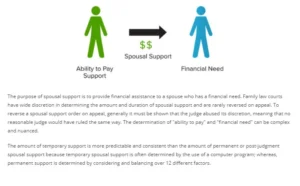
If there is a demonstrated need by one spouse, and a demonstrated ability to pay relative to the other spouse, a divorce court will likely make an order for spousal support payable to the spouse in need. The determination of the amount, duration, and other terms of the spousal support order can be very complex.

Spousal Support

Free rent and meal allowances may be income. Deferred salary is income, as are recurring payments from family members (gifts) that are not loans or early inheritance. Unallocated, lump-sum, personal injury recovery, or annuity, payments are generally not characterized as income. Student loans and unrealized gain in shares of stock are not income. The proceeds received from the sale of stock that were reinvested are not income available for support.

A family law court may order one party to pay spousal support to the other, if that party has the need and the payor has the ability to pay. Spousal support payable before the judgment is entered is called temporary support, and spousal support paid after the judgment is called permanent spousal support.

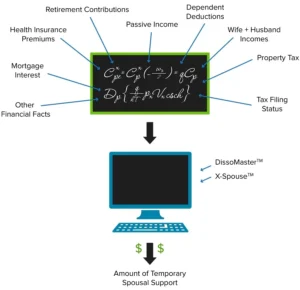
Spousal support paid prior to the entry of the Judgment is characterized as temporary spousal support or pendent lite spousal support. Temporary spousal support may be ordered at a Request For Order (RFO) and is designed to maintain the status quo of the parties, where possible. The amount of temporary spousal support is often determined with the utilization of a formula accessed through the use of a computer software program (DissoMaster or X-Spouse).

Temporary spousal support may be ordered retroactively to the filing date of the Request for Order (RFO) seeking spousal support. Generally, the payor-spouse is credited with payments made to the payee-spouse or paid for that spouse’s benefit. However, a spousal support order at the trial may not be made retroactive to the date of the Petition unless a spouse had previously requested temporary spousal support (Mendoza v. Cuellar). A family law court may order temporary spousal support pending the determination of issues involved in an Out-of-State divorce (Gromeeko v. Gromeeko).

Temporary Spousal Support

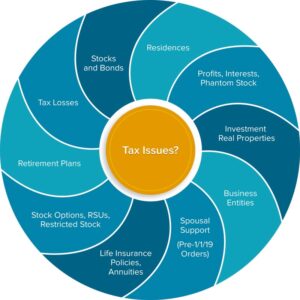
Tax Issues

At the divorce trial, permanent spousal support may be ordered. The term “permanent” is misleading because permanent spousal support may be ordered for a limited period of time. The term permanent is intended to distinguish this spousal support from temporary spousal support. This spousal support is also referred to as post-judgment or long-term spousal support.

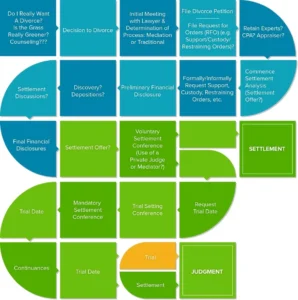
Potential Sequence of Steps and Procedural Events in a Divorce

Spousal Support Retroactivity

A court is to look to all circumstances when determining whether to extend spousal support (IRMO Wilson).There are many circumstances that may justify a modification of a permanent spousal support including the following:

  1. Decrease in income of the payor-spouse;
  2. Increase in income of the payee-spouse;
  3. End of child support;
  4. Discharge by payee-spouse of all community debts assigned to payee (IRMO Clements);
  5. Unrealized expectations that payee-spouse would be self-supporting (IRMO Beaust);
  6. Payee’s support of adult children (IRMO Serna);
  7. Cohabitation and romantic relationship;
  8. Increase in child support (IRMO McCann);
  9. Payor-spouse’s 65th birthday and retirement (IRMO Reynolds).

The following may not constitute a change of circumstances:

  • Payee-spouse paying expenses of daughter and two grandchildren (IRMO Serna);
  • Ability to access retirement funds without penalty (IRMO Dietz);
  • Generally, mere passage of time;
  • Increased income by payor-spouse without a showing by the payee-spouse that the original award failed to meet the marital standard of living;
  • Payee-spouse’s pursuit of an advanced degree as opposed to obtaining a job; and
  • Payee-spouse’s continued disability in a short-term marriage.

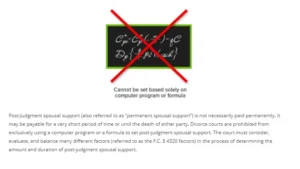
The award of permanent spousal support is based on the factors set forth in Family Code § 4320 as opposed to being based on the “status quo” as is the standard for temporary support matters. The divorce court cannot set permanent spousal support exclusively using the computer software formula used in setting temporary spousal support. Family Code § 4320 sets forth specific factors that the divorce court must consider:

a. The extent to which the earning capacity of each party is sufficient to maintain the standard of living established during the marriage, taking into account all of the following:

1. The marketable skills of the supported party; the job market for those skills; the time and expenses required for the supported party to acquire those skills; and the possible need for retraining or education to acquire other, more marketable skills or employment.

2. The extent to which the supported party’s present or future earning capacity is impaired by periods of unemployment that were incurred during the marriage to permit the supported party to devote time to domestic duties.

Permanent Support

b. The extent to which the supported party contributed to the attainment of an education, training, a career position, or a license by the supporting party.

c. The ability of the supporting party to pay spousal support, taking into account the supporting party’s earning capacity, earned and unearned income, assets, and standard of living.

d. The needs of each party based on the standard of living established during the marriage.

e. The obligations and assets, including the separate property, of each party.

f. The duration of the marriage.

g. The ability of the supported party to engage in gainful employment without unduly interfering with the interests of dependent children in the custody of the party.

h. The age and health of the parties.

i. Documented evidence, including a plea of nolo contendere, of any history of domestic violence, as defined in Section 6211, between the parties or perpetrated by either party against either party’s child, including, but not limited to, consideration of emotional distress resulting from domestic violence perpetrated against the supported party by the supporting party, and consideration of any history of violence against the supporting party by the supported party.

j. The immediate and specific tax consequences to each party.

k. The balance of the hardships to each party.

l. The goal that the supported party shall be self-supporting within a reasonable period of time. Except in the case of a marriage of long duration as described in Section 4336, a “reasonable period of time” for purposes of this section generally shall be one-half the length of the marriage. However, nothing in this section is intended to limit the court’s discretion to order support for a greater or lesser length of time, based on any of the other factors listed in this section, Section 4336, and the circumstances of the parties.

m. The criminal conviction of an abusive spouse shall be considered in making a reduction or elimination of a spousal support award in accordance with Section 4324.5 or 4325.

n. Any other factors the court determines are just and equitable.

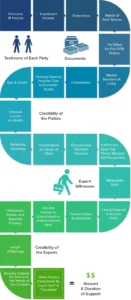
F.C. § 4320 Factors

The marital standard of living is relevant to the determination of spousal support. However, it is just one of the Family Code Section 4320 factors (IRMO Smith / IRMO Zywiciel). It is neither a ceiling nor a floor for the amount of spousal support. The marital standard of living may be looked at by the divorce court as a benchmark. The divorce court may define the marital standard of living specifically with a dollar level or generally in terms like “middle class standard of living” (IRMO Kerr).

The divorce court must consider the marital standard of living of both parties, not just that of the payee spouse (IRMO Andreen).

Testimonials

HEAR FROM MINYARD MORRIS CLIENTS

Contact Us

SCHEDULE A MINYARD MORRIS CONSULTATION

Contact Minyard Morris now to schedule a consultation with our attorneys and legal professionals.