Huntington Beach Spousal Support Attorney
Navigating the complexities of family law, which include divorce, child custody, and alimony, can deeply affect your life and your loved ones. During such pivotal times, the guidance of a seasoned, empathetic legal team is essential.
Minyard Morris is recognized as a premier family law firm serving the residents of Huntington Beach, renowned for its superior legal representation and genuine care. Here’s why engaging Minyard Morris is a judicious choice.
In 2024, the esteemed and independent lawyer rating service, Best Lawyers in America® listed 19 of 20 Minyard Morris family law attorneys.

Exemplary Family Law Expertise
With over 350 years of combined legal experience, our team of 20 family law attorneys at Minyard Morris has been a pillar of the Orange County legal community since 1977, serving Huntington Beach since that time. Our in-depth local experience enhances our adeptness at managing intricate cases involving all aspects of orders and stipulations relative to the initial orders for spousal support and subsequent post judgment modifications of spousal support orders.
Our unwavering dedication is aimed at achieving the most favorable outcomes for our Huntington Beach clients, backed by decades of specialized knowledge and the experience of handling thousands of family law matters in Orange County.
Inside Our Firm’s Secret Weapon: Weekly Collaboration Meetings
At Minyard Morris, we have a not-so-secret weapon that has fueled our success for decades: our weekly collaboration meetings. Three times a week, our 20 skilled family law attorneys gather to share insights, brainstorm solutions, and strategize every angle of our Huntington Beach clients’ cases. This isn’t just a meeting; it’s a powerhouse session of over 350 years of combined legal experience working together for our Huntington Beach clients.
The Magic Behind Our Meetings
You might be curious—what really happens behind these closed doors? Every Monday evening, Tuesday at noon, and Thursday at noon, we meet to dissect the complexities of our Huntington Beach active cases. This isn’t a casual chat; it’s essentially a mandatory, high-energy strategy session where every divorce lawyer’s input is valued.
The topics we cover are diverse and far-reaching: How do we handle a particular opposing counsel? What approach will resonate with the assigned judicial officer? Are there recent appellate court decisions or new case laws that could impact our strategy?
Have we encountered similar cases in the past that might inform our current approach? We dive into everything from settlement options and evidentiary issues to trial tactics and the probability of success on key issues. These meetings are the heartbeat of our practice.
More Than Just Talk: Why It Matters to Our Hunting Beach Clients
So, what does all this mean for you as a Huntington Beach client? It means that when you hire us, you get more than a single family law attorney; you get a team of 20 family law attorneys who come together regularly to ensure you get the best possible representation. It’s like having a panel of experts backing your case, each bringing unique insights to the table.
Compare that to working with a smaller firm, where your divorce lawyer may only consult with one or two colleagues, and the difference becomes clear. Logic dictates that a client that is represented with the input of a team of 20 family law attorneys, with over 350 years of experience and the resources of Minyard Morris, will achieve a better result.
Here’s an example: During our meetings, one of our divorce attorneys might raise a question about the legal support for a particular position. Often, another attorney has already dealt with a similar issue and can immediately provide insights, citing relevant court cases.
This rapid exchange of knowledge can save countless hours of research (attorney’s fees) and provide a clear direction for moving forward. Sometimes, an attorney might just need a quick reality check on a contentious issue, and the group provides valuable input that shapes the strategy.
Dedicated Local Focus
For over 46 years, our attorneys have been deeply embedded in Huntington Beach and the broader Orange County’s legal fabric. We don’t merely practice family law; we are fully engaged in it, shaping our services specifically for Huntington Beach residents. Our firm meets three times each week to strategize, ensuring a well-rounded and potent approach that maximizes the collective insight of our firm, offering a significant advantage to our clients.
Personalized Client Care
We understand that each family law case involving spousal support is distinct, with unique personal stories. Minyard Morris is committed to understanding your specific situation and objectives, developing a customized strategy that meets your needs.
Compassion and Empathy
Dealing with family law issues involves navigating not just legal challenges but emotional ones as well. Our team is proficient in handling these sensitive matters with both professionalism and empathy. At Minyard Morris, we strive to provide a supportive environment where our Huntington Beach clients feel comfortable discussing their concerns, which can alleviate the stress of legal proceedings.
Robust Negotiation and Litigation Skills
Although we prefer to resolve disputes through amicable negotiation and mediation, our readiness to litigate is resolute when necessary. Our balanced approach to assertive advocacy and strategic negotiation is designed to safeguard your interests, whether in discussions or in the courtroom.
Advantages of a Larger Firm
Choosing a large firm like Minyard Morris brings substantial benefits to our Huntington Beach clients. Our frequent in-person meetings facilitate a dynamic exchange of ideas and strategies, enhancing the representation of your case with the collective expertise of our entire team.
Our cohesive, single office in person law firm ensures uninterrupted and comprehensive support for our clients, alongside the capability to swiftly handle emergencies. We believe that lawyers working remote cannot provide the same personal attention as a firm of lawyers that are in the office each day.
Specialized Orange County Expertise
All 20 of our family law attorneys focus their practice exclusively on cases within Orange County, granting us unmatched local legal expertise. This focus allows us to deliver exceptional legal services without diluting our effectiveness across multiple counties.
Proven Track Record
The success of our firm is evidenced by the positive outcomes we secure and the glowing endorsements from our clients, many of whom were referred by previous clients. This underscores our strong reputation and the trust we have established in Huntington Beach and its neighboring cities.
Comprehensive Spousal Support Knowledge
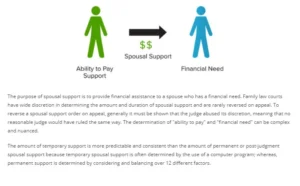
Spousal support law is intricate, governed by extensive statutes and case law, with judges enjoying broad discretion in issuing orders. Achieving the correct result initially is critical, as spousal support orders are seldom overturned on appeal. These orders may cover several aspects, including the amount, duration, possible step-downs, and related income findings, among others.
Spousal support can also be non-modifiable if stipulated in the judgment. The setting of the marital standard of living often involves significant litigation, given that it is not a fixed figure and is subject to judicial discretion. Our firm is equipped to handle these complexities adeptly.
The law relative to a 10-year marriage is quite nuanced. While the difference between a 10 year, an 11 year and a 15-year marriage may be significant. It may not be as significant as one would believe. The issue controlled by the length of marriage is the duration of spousal support. A nine-year marriage can be treated as a 10-year marriage and an 11-year marriage may be treated very closely to a 9 year marriage.
Spousal support orders are always modifiable unless the parties agreed in writing that the terms of the spousal support order are non-modifiable. Unless the spousal support in non-modifiable, the court may modify spousal support orders upon a significant change of circumstances which may include a change in income, a change in health and a myriad of other potential changes.
Separate Property in California Divorce Law
Divorce can be a highly involved process, particularly when it comes to dividing assets. In California, understanding the distinction between separate property and community property is essential for determining how assets are allocated between spouses. The nuances of this distinction significantly influence divorce outcomes. This guide offers a glimpse at what constitutes separate property, how it relates to community property, and how both are managed in divorce proceedings.
What Qualifies as Separate Property?
In California, separate property refers to assets that are owned solely by one spouse. These assets generally fall into three categories:
- Pre-marital possessions: Property acquired by a spouse before marriage.
- Gifts and inheritances: Assets received as a gift or inheritance by one spouse, regardless of whether they were acquired before or during the marriage.
- Post-separation acquisitions: Any property obtained after the legal separation of the spouses.
The timing and method of acquisition play a central role in determining whether an asset is classified as separate or community property. On the other hand, community property includes all assets and income acquired by either spouse during the marriage.
In the context of divorce, community property is typically divided equally between the parties, though this doesn’t necessarily mean each asset will be split evenly. Instead, the court ensures an equal distribution of the total value of community property, potentially assigning different assets to each spouse and, if necessary, ordering equalization payments to balance the distribution.
Are Inheritances Separate Property?
Gifts and Inheritances: Safeguarded as separate property.
In California, gifts and inheritances are classified as separate property, even if received during the marriage. However, it is essential to ensure that these assets are not commingled with community property, as doing so could blur the distinction between the two.
For instance, if inherited funds are deposited into a joint account that contains community property, the separate nature of those funds may be compromised, potentially subjecting them to division in the divorce. To prevent this, it is advisable to keep inherited or gifted assets in a separate account, clearly distinguishing them from shared marital funds.
Does the Community Acquire an Interest in a Separate Property Business?
Separate Property Businesses: Complexities in Divorce
When one spouse owns a business prior to the marriage, the business is generally considered their separate property. However, if the business increases in value during the marriage—particularly if that growth is a result of the owner-spouse’s efforts—the community may have a claim on a portion of that increase in value.
California courts use two main approaches to determine how much of the business’s appreciation belongs to the community:
- Van Camp Method: This method is used when the growth of the business is attributed primarily to factors like market conditions or capital investments rather than the direct efforts of the owner-spouse. The community’s claim is generally limited to the reasonable value of the owner-spouse’s labor during the marriage.
- Pereira Method: This approach is used when the business’s success is largely driven by the owner-spouse’s personal efforts and work. In this scenario, the community is entitled to a share of the business’s increased value, after allocating a reasonable return on the owner’s separate property interest.
In some cases, both methods may be used if the business’s structure or nature evolves significantly over the course of the marriage. However, the non-owner spouse does not gain ownership of the business itself—their right is confined to financial reimbursement for the portion of the business’s increased value attributed to community efforts.
How is a Business Valued in a Divorce?
Valuation of Businesses During Divorce
If a business is formed or purchased during the marriage, it is typically regarded as community property. Generally, the court will award the business to the spouse who is actively managing it, but the first step is to determine the business’s value. Valuing a business in divorce proceedings can be a complicated process that usually requires the expertise of forensic accountants or financial professionals.
Two standard methods for valuing businesses include:
- Capitalization of Earnings: This method estimates the business’s value by projecting its future profitability based on its current earnings.
- Capitalization of Excess Earnings: This method evaluates the business’s assets and the return generated from those assets to calculate its value.
The court seeks to determine the investment value of the business to the spouse who will retain it, which is often different from its market value. If the court orders an equalization payment, it is with after-tax dollars and is not deductible for tax purposes by the paying spouse.
Can the Community Acquire an Interest in a Separate Property House?
Homes Owned Before Marriage: The Moore/Marsden Formula
When one spouse owns a home in Huntington Beach or throughout California before the marriage, that property is considered their separate property. However, if community funds—such as income earned during the marriage—are used to pay down the mortgage or improve the home, the community may acquire an interest in the home’s value.
The court applies the Moore/Marsden formula to calculate the community’s share of the property’s appreciation. This formula considers the portion of the mortgage that was paid with community funds, along with any increase in the home’s value during the marriage. The formula ensures that the non-owner spouse receives a fair share of the appreciation attributable to community contributions.
If the owning spouse wishes to convert the home into community property, they must sign a transmutation agreement, a written document that clearly states the intent to change the ownership of the property. Verbal agreements or informal discussions are not sufficient under California law to alter the classification of property.
How is a Date of Separation Determined?
The Role of the Date of Separation
In Huntington Beach and throughout California, the date of separation is a critical factor in determining when the accumulation of community property ceases. Any assets acquired after this date are considered separate property.
Establishing the date of separation requires clear evidence that one spouse has definitively communicated their intention to end the marital relationship, either through words or actions. Merely living apart or taking a temporary break does not constitute separation unless accompanied by a clear intent to permanently end the marriage.
Documenting the separation through a formal communication, such as an email or written message, can help avoid disputes regarding the timing of the separation. The date of separation can significantly influence the division of assets, spousal support calculations, and the allocation of post-separation debts.
Can a Spouse Receive Credit for Paying Community Expenses After the Date of Separation?
Managing Finances After Separation: Handling Community Expenses
Once the date of separation is established, each spouse’s earnings become separate property. However, issues can arise when one spouse uses their post-separation earnings to cover community expenses, such as joint debts or mortgage payments. In such cases, the paying spouse may be entitled to reimbursement, unless the payment was for an expense that benefited only them.
To minimize confusion and potential disagreements, it is recommended that separating spouses immediately segregate their finances. This includes closing joint accounts, ceasing the use of shared credit cards, and clearly defining each spouse’s financial obligations moving forward.
What Steps Should You Take at Separation?
Steps to Safeguard Your Financial Interests During Separation
To protect your financial interests during the separation process, it is important to take the following proactive steps:
- Open a new, separate bank account for your earnings.
- Close any joint accounts and set up individual credit cards.
- Update the passwords on your financial and personal accounts.
- If you are on a shared phone plan, consider switching to an individual plan.
- Set up a separate email account for communications with your Huntington Beach Divorce lawyer attorney.
- Minimize or avoid social media activity until your divorce is finalized.
- Seek legal advice from a Huntington Beach Orange County divorce lawyer before making any significant financial decisions, such as investments or large purchases.
Contact Our Experienced Huntington Beach Spousal Support Lawyers
Choosing the ‘right’ family law firm for your Huntington Beach divorce is crucial to the success of your case and your future well-being. Minyard Morris combines sharp legal skills, strategic focus, and compassionate representation to assist Huntington Beach residents through the challenges of family law. There are over 600 divorce lawyers practicing in Orange County. Although it may seem like an impossible task to hire the “right” family law firm. The choice is not difficult if you carefully compare lawyers and law firms.
If the outcome is important to you, take the time to carefully compare lawyers and law firms. Retaining the “right” family law attorney can significantly impact your financial and emotional life for years. Choose an alimony lawyer who will serve both as your advocate and your trusted advisor through this challenging time.
Retain the law firm that Huntington Beach knows and trusts. Call Minyard Morris at (949) 724-1111 or contact us online to learn how we can guide you to a favorable resolution with confidence.