Irvine Child Support Lawyer

Irvine Child Support Lawyer

Irvine Child Support Attorneys

One of the most contentious topics in all of California’s family laws is child support. As a parent, you may be concerned over the financial provisions of your child following a divorce, legal separation, or paternity issue. Regardless of whether you are the parent seeking support or the parent defending against support obligations, an Irvine child support lawyer from Minyard Morris is here to help. We have the experience necessary to offer fierce advocacy in your case.

In the state of California, both parents have a duty to care for their child’s needs, whether that child be a minor or an adult individual with a disability. Regardless of marital status, this responsibility still functions as part of the law.

If you believe you may be entitled to child support or believe that you are paying too much, the team at Minyard Morris is here to offer aggressive representation, compassionate counsel, and work to protect your rights.

Trusted Irvine Child Support Lawyer

What Is California Child Support?

Irvine, California follows very strict guidelines as to how child support is calculated. There may be room for exceptions in certain cases; however, the typical factors considered in determining a child support award can include:

  • The income of the involved parents.
  • The amount of time each individual parent spends with their child.
  • Any other potential factors, including the special needs of a child or that child’s standard of living.

In determining the income of the parents, the courts will examine all sources of monetary provision, including:

  • Wages and any earnings from self-employment.
  • Pension plans.
  • Unemployment benefits.
  • Workers’ compensation benefits.
  • Interests from investments or business ownership.
  • Disability benefits.
  • Income from rental properties.
  • Benefits from Social Security.
  • Stock dividends.
  • Lottery winnings.

The courts will then work to deduct the cost of any mandatory expenses of each parent to calculate income solely to be used for the purpose of child support. Some of these deductions might include:

  • Health insurance premiums.
  • Mandatory union dues.
  • Already existing child support or spousal support orders.
  • Any costs related to the raising of children from other relationships.
  • Retirement plan contributions that are mandatory.

In addition to these considerations, the judge will look at how much time each parent spends with their child individually when making their ruling on support. If one parent spends less time with their child than the other, this parent will most likely be called upon to pay more in child support.

Minyard Morris: Protecting Your Rights in a Child Support Case

The child support system of California is complex and understanding it takes a vast knowledge of the legal terms and laws involved. At Minyard Morris (formed over 48 years ago), you won’t be getting the service of a single attorney but a team of 20 family lawyers with over 350 years of combined experience between them. We dedicate our time and resources to top-tier legal counsel and representation and are ready to protect your rights as both a parent and an individual in your support case.

When you hire the team at Minyard Morris to help you through a child support case, you can expect us to take the following actions:

  • Educating you on your legal rights as a parent and the receiver or payer of the child support in question.
  • Helping to identify any potential deviations or add-ons in your child care case should your needs or those of your child call for these situations.
  • Assisting you in understanding how and when child support enforcement occurs, as well as moments in which seeking a modification to an existing ruling may be necessary.
  • Negotiating a child support agreement with your ex and their legal team.
  • When negotiations become impossible or do not provide a satisfactory outcome, our team has the resources and experience necessary to litigate your position before a judge in court.

Potential Add-Ons in California Child Support

In some cases, a judge might award a child support order with additional amounts that must be paid, otherwise known as “add-ons.” These add-ons can include childcare expenses, uninsured health costs, educational expenses, and travel costs for visitation.

Best Irvine Child Support Attorneys

FAQs

Q: What Does Child Support Cover?

A: Child support is designed to help provide for things beyond the basic needs of clothing and food. Child support is also supposed to cover items such as insured or uninsured medical bills, travel or transportation costs, entertainment expenses, education costs, college tuition and related expenses, and after-school activities and their related costs.

Q: What Are Some Reasons to Seek Modifications to Child Support?

A: There can be several reasons to seek the modification of a child support order in California, though it will be up to a judge to decide if these reasons warrant a change. The most common causes of modification to a child support ruling include a job loss or other sudden change in income, the changing health needs of the child, such as when an injury or illness is suffered, and the changing health needs of one or both of the parents.

Q: What Will a Child Support Lawyer Cost?

A: It is hard to offer a definite number as to how much a child support lawyer might charge for their services in the state of California as there are several factors that can affect these cases and the final costs of an attorney. These factors include the complexity of the case, the duration, and the overall experience of your lawyer.

Q: How Long Do Child Support Payments Last?

A: Most often, in the state of California, child support payments must be made until that child is no longer considered a minor. However, there are cases in which these payments are extended, such as in situations where an adult child is still attending high school and is not self-supporting yet or in cases where the child is an adult with a disability.

Speak to a Top-Tier Child Support Attorney Today

Regardless of your position in a child support situation, the team at Minyard Morris is here for you. We are firm believers that superior legal service starts with being proactive and working to anticipate any disputes in your support case before they arise in order to mitigate their damage to your side of the case. Contact us today to schedule an initial consultation and let us help you with aggressive advocacy and compassionate counsel.
Irvine Child Support Lawyer FAQ

A family law court may look to the parents income and assets in determining the amount of child support.

Structured annuity payments paid relative to a personal injury do not constitute income for the purposes of determining child support.

Spousal support is not income to be included in the calculation of guideline child support. (IRMO Corman).

A wealthy party may avoid extensive discovery if a stipulation is reached providing that the party has the ability to pay any reasonable child support. (Estevez v. Superior Court and IRMO Aylesworth).

When there is a dispute as to the income of a party, the divorce court may look to a party’s loan application as presumptive evidence of income. (IRMO Calcaterra & Badakhsh). The representations on the loan application can be received by the divorce court as admissions of the income earned.

A party may not reduce his or her income by voluntarily making payments to reduce debt that is not currently due to a third person or entity. For example, a party prepaying a mortgage cannot claim a reduction in income. (IRMO Kirk).

Voluntarily deferring income is not a proper basis for a reduction of spousal or child support. (IRMO Berger).

Proceeds from the sale of a business that are reinvested are not income available for child support. (IRMO Pearlstein).

The increase in the amount of equity in a home is not income for purposes of calculating child support. (IRMO Henry).

Child support is based upon the gross (not net) income of the parties, including the following types of income and benefits:

  • Salary;
  • Bonuses;
  • Royalties;
  • Rents;
  • Workers compensation;
  • Unemployment benefits;
  • Disability benefits;
  • Social Security benefits;
  • Employment benefits;
  • Deferred income;
  • Perquisites;
  • Military allowances;
  • Meal allowances;
  • Recurring Gifts;
  • Most annuity payments; and
  • Vested stock options/RSUs/Profits Interests.

The following items are not income available for child support:

  • One time inheritances;
  • Unallocated lump-sum personal injury recoveries;
  • Loans of all types including student loans;
  • Life Insurance proceeds; and
  • Proceeds of the sale of stock in a business that are reinvested.

Child support is payable until a child completes high school, but not after a child attains the age of 19.

Child support does not automatically end on the death of the payor parent, even if the primary parent had child custody. (IRMO McCann).

Child support may be payable to adult children who are unable to support themselves.

What is Guideline Child Support?

Guideline child support is calculated with the use of a computer program that requires the input of a number of factors. The most significant of which are custodial time-share and income (as defined by the Family Code).The purpose of child support is to provide a level of support that allows the child to share the parent’s economic station in life.

California family law states that parents must contribute to the support of a child, according to a detailed formula utilized in the software programs “X-Spouse” and “Dissomaster.” These programs generate “guideline” child support.

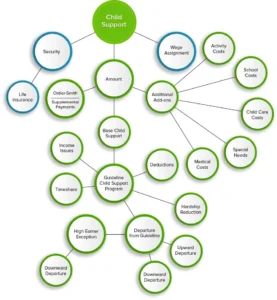
Child support is more involved than simply inputting the incomes of the parties into a computer program and pressing enter. The computer program generates the guideline child support amount. A family court may order a party to pay for additional expenses, referred to as “add-ons,” in addition to the base child support. Add-ons may include such things as child care, activity costs, schools costs, travel costs, health insurance premiums, and medical costs not paid by insurance. Other issues that may need to be addressed include imputation of income, determining the representative period of past earnings to determine the most probable future income, how to treat fluctuating income, determining whether money received is income, etc.

A family court may order “add-on” costs be paid in full by one party, or divided between the parties in equal or unequal shares.

A family court may order a base level of child support, and a supplemental payment of any additional income received over the base salary. This supplemental child payment is referred to as an “Ostler-Smith” payment.

Child Support Decision Tree

Family Law Interconnectivity Overview – Children

A family law court may depart or deviate from guideline child support, even though the amount of guideline child support is presumed to be the correct amount. A family law court has the discretion to determine whether or not to depart from guideline child support but must make specific findings to justify the departure (IRMO Hall).

The following circumstances may justify departure from guideline child support:

  • Special needs of a child (IRMO Cryer);
  • Exceptionally high earner;
  • Deferred home award to payee party;
  • A party is not contributing to the needs of the children at a level commensurate with their time share;
  • Unjustness of the guideline formula in the particular circumstance;
  • Payment of significant amount of community consumer debt incurred for basic living needs (County of Lake v. Antoni); and
  • Mortgage free housing. (IRMO Schlafly).

A client should expect their divorce lawyer to be beyond candid, and explain to them the strengths and weaknesses of the case, and the probable outcome of litigation at the first attorney-client meeting and at every stage during the process, as new facts unfold. A client should have the opportunity to make informed and timely decisions about their children. Our Orange County divorce lawyers are known for telling our clients the good, the bad, and the ugly about child custody matters – early and often. Clients deserve to hear the truth, not a sales pitch.

Temporary child support is ordered at the Request For Order (RFO) stage of the case. Post-judgment child support, is ordered at the trial. Guideline child support ordered at both stages of a case, is determined by the same formula.

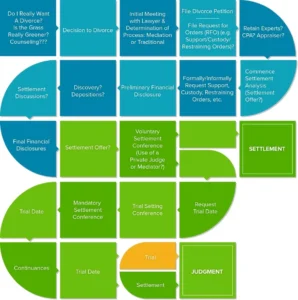
Potential Sequence of Steps and Procedural Events in a Divorce

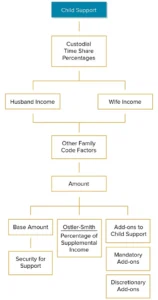
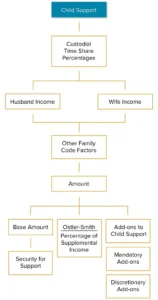
Child support is a complex area of family law and is more involved than simply inputting the incomes of the parties into a computer program and pressing enter. The computer program generates the guideline child support amount. A family court may order a party to pay for additional expenses referred to as “add-ons” in addition to the base child support. Add-ons may include such things as child care, activity costs, schools costs, travel costs, health insurance premiums and medical costs not paid by insurance. Other issues that may need to be addressed include issues like imputation of income, determining the representative period of past earnings to determine the most probable future income, how to treat fluctuating income, determining whether money received is income, etc.

A family court may order “add-on” costs be paid in full by one party or divided between the parties in equal or unequal shares.

A family court may order a base level of child support and a supplemental payment of any additional income received over the base salary. This supplemental child payment is referred to as and “Ostler-Smith” payment.

“Child Support Decision Tree

Family Law Interconnectivity Overview – Children

Conflicts may exist relative to the methodology of calculating custodial time sharing. Generally, hours of parental responsibility are counted towards the time share percentages. This means that when a child sleeps at one parent’s home, that parent is credited with the sleep hours in the time share calculation. Likewise, if one parent is responsible for issues that arise during the school day, that parent is credited with the school hours. One of the significant factors that determines guideline child support is the child custody time share percentages. A higher child custody time share for the payor decreases child support, and a lower child custody time share for the payor increases child support.

“Child Support

Child support is always modifiable. However, it may only be modified retroactively to the date of the filing of a Request For Order (RFO) seeking the modification.

Child support is modifiable if there has been a material change in circumstances since the date of the last order. A change in income or a change in the child custody timeshare may be a material change in circumstances. However, a substantial reduction in income from employment may not justify a reduction in child support, if the payor has substantial income from investments.

The parties may not bind the family law court to a specific standard of review to modify a child support order. (IRMO Cohen).

Common examples of circumstances that may warrant a modification of child support include: a change in income of either party, decrease in the income of either party or change in custodial time share.

Time Share Factor

Income Factor

A divorce court must order one or both parties to maintain health insurance for the children, if available through employment at no or nominal cost.

A divorce court will generally order each party to pay all, or a portion, of a child’s medical expenses not paid by insurance. The court can order the parties to pay disproportionate shares of health costs.

Testimonials

HEAR FROM MINYARD MORRIS CLIENTS

Contact Us

SCHEDULE A MINYARD MORRIS CONSULTATION

Contact Minyard Morris now to schedule a consultation with our attorneys and legal professionals.