Orange County Divorce Modification Lawyer

Orange County Divorce Modification Lawyer

Although divorce orders carry the weight of finality, some life changes require a modification to custody or support orders. Divorce modification cases come with unique challenges, and success requires substantial evidence and sound legal arguments. Residents in Orange County can rely on the legal services of an Orange County divorce modification lawyer to manage the complexities of Orange County divorce modification laws.

Best Orange County Divorce Modification Lawyer

Focused Legal Representation for Divorce Modifications in Orange County

At Minyard Morris, our team of award-winning family law attorneys understands that life doesn’t stand still following a divorce. Whether you are seeking a modification to update your support or custody order, our industry-leading law firm manages your case so you are positioned for a favorable outcome in court.

With over 48 years of focused service in Orange County and more than 150 five-star Google reviews, Minyard Morris is trusted by clients and respected by legal peers. Our attorneys have earned repeated recognition from Super Lawyers and bring unmatched insight into every case. We approach divorce modifications with clarity and precision.

Understanding Modifications in Orange County

Requests for divorce modifications are common in a state that has a reported divorce rate of 17.77 per 1,000 married women. According to Orange County Child Support Services, 6,340 new support cases were opened in Fiscal Year 2023–24. Nationally, about 80% of single-parent households are led by mothers, many of whom seek or respond to custody and support modifications.

Whether due to job changes, relocation, or evolving parenting needs, modifications often arise in busy communities like Irvine, Anaheim, and Mission Viejo. In Orange County, these matters are typically handled at the Lamoreaux Justice Center in the City of Orange, the central courthouse for family law or the Central Justice Superior Court on Civic Center Drive West.

Can My Divorce Order Be Modified?

The family courts in Orange County allow custody and support court orders to be modified when there has been a significant ongoing change in circumstances. Spousal support, child support, and custody orders can all be modified through the efforts of a divorce modification attorney. The process for modifying a spousal support order has specific legal requirements that must be met.

One key step for securing a modification is to work with your attorney to gather evidence that supports your request for a modification and documents the change of circumstances. This could include proof that you have become disabled or seriously ill. Any party who pays child support but begins earning substantially more may be required to pay a higher amount in child support.

Other order modification cases involve the custodial parent moving away with the child. The non-custodial parent, or the one with fewer custody rights, can challenge this move, especially if moving the child is not in their best interests, as these parental relocation cases present unique legal challenges.

Modification efforts can also be contested if the other party does not believe that a modification is needed or warranted. To settle requests for modifications, the courts set hearings where both parties appear, make arguments, and present evidence supporting their respective legal arguments.

Why You Should Hire a Divorce Modification Lawyer

Whether you are seeking or fighting a divorce modification, one important first step should be to hire a divorce modification lawyer. A modification attorney understands the state’s laws and procedures for modifying a court order. Having legal representation can be critical when preparing for your day in court.

An attorney manages the process of gathering evidence to support your effort. If you need to testify, your attorney will explain what types of questions you may be asked. That way, you are not thrown off by unexpected questions. As with many court matters, the key to successfully obtaining or fighting a modification lies in careful preparation.

Top rated Orange County Divorce Modification Attorney

Contact an Experienced Orange County Divorce Modification Lawyer

Life often changes, and so can the terms of your divorce. Whether you’re requesting a modification of spousal support, child custody, or child custody, the court requires evidence of a substantial change in circumstances before a judge will consider modifying a court order.

At Minyard Morris, we focus on providing legal services that can allow you to modify a court order or stop your former spouse from doing so. Our team of award-winning lawyers offers over 350 years of combined experience to benefit our clients. Our firmwide weekly strategy meetings make sure our clients receive exceptional legal services. Contact our office today to pursue the changes you need.

Orange County Divorce Modification Lawyer FAQ

The basis for a modification of a spousal support order is a ‘change in circumstances.’ The ‘change in circumstances’ test applies to both divorce court orders and to stipulations entered into by the parties. The circumstances that are evaluated by the divorce courts in determining whether an order should be modified, generally relate to the changes in the respective needs of each party and the changes in the respective earnings of each party.

The ability to earn versus the actual earnings, may also be relevant in the analysis.

In the analysis as to whether to impute income to a party relative to spousal support, the divorce court is to look to a reasonable work regimen for the industry involved. (IRMO Simpson). A court need not find a bad faith motive on the part of the payor (who is unemployed or under-employed) in order to impute income to a party. (IRMO Padilla).

The loss of a well-paying job and a good faith effort to obtain another well paying job that results in a lower level of compensation will generally constitute a change of circumstances and a reduction in spousal support.

Unrealized expectations relative to earnings may also be relevant and may constitute a change in circumstances. (IRMO Beaust). The failure of a supported party to become employed or self-supporting may justify a modification of spousal support. Generally, the mere passage of time alone does not justify a modification of spousal support. (IRMO Wilson).

An increase in the earnings of the payor spouse by itself does not justify an increase in spousal support. For such an increase to constitute the basis for a modification of spousal support, the supported spouse must prove that his or her needs were not satisfied by the spousal support ordered in the judgment. In other words, if the amount of spousal support ordered in the divorce judgment was capped due to the payor party’s earnings and was not sufficient to meet the supported spouse’s marital standard of living at the time the divorce judgment was entered, an increase in the income of the supporting spouse may constitute the basis for an increase in spousal support. (IRMO Hopwood and IRMO Hoffmeister).

Marital standard of living is relevant to a modification of spousal support but it is just one of many factors and it is not dispositive (IRMO Smith) and the marital standard of living is less significant with the passage of time. (IRMO Rising).

The supporting spouse cannot be required to work beyond the date of normal retirement for the industry in question in order to pay spousal support to the supported spouse. In other words, you cannot impute earnings to a party after the normal retirement age of 65. (IRMO Reynolds).

Spousal Support is Modifiable

The divorce court will look to a number of factors in making the determination relative to the move away: extent of shared child custody, willingness to place the children’s best interests first, reasons for the move, relationship of the child with each parent, distance of the move, age of the child, ability of the parents to cooperate and communicate, stability and continuity, relationship of the parents, and the child’s wishes (IRMO La Musga).

Where parents have a working, shared child custody arrangement, the divorce court must conduct a hearing to determine whether the relocation of the child’s residence is the child’s best interests.

If a child custody order has not been made, or if the child custody order is not a ‘final’ order, the family law court will use the ‘best interests of the child’ test in making the decision on the relocation.

Final or permanent (also known as post-judgment) child custody orders may be modified if there has been a ‘significant change in circumstances’ since the last child custody order was entered. (IRMO Keith R.). It is the burden of the parent who is attempting to modify the child custody order to show that the required circumstances have changed. The changes that divorce courts look for in making this determination relate to the child’s health, education and welfare. Different divorce courts may evaluate changes of circumstances differently. Here also the family law courts have wide discretion.

A final child custody order is an order that specifically states that it is a final order or states that it is a “Montenegro” order. (IRMO Montenegro).

If the child custody order is not clearly designated as a “final” child custody order, a modification may be based on the child’s ‘best interests.’ The ‘best interests’ test has a lower threshold than the ‘substantial change in circumstances’ test. In other words, using the ‘best interests’ test, the divorce court may consider any and all relevant factors in making the determination, whereas with the ‘substantial change of circumstances’ test, the divorce court may only look to whether there has been a substantial change in the relevant facts and circumstances that existed on the date of the last child custody order. If there has not been a change in the facts and circumstances, the divorce court cannot modify the child custody order, even if the court believes that it would be in the child’s best interests to make a change in the order.

Standard for Modification

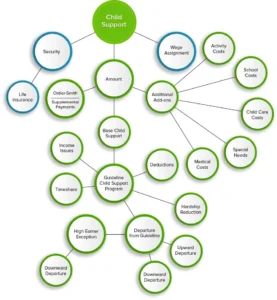
Child support is calculated using a computer program (Dissomaster/X-Spouse), taking into consideration a number of factors including: the parent’s respective incomes, child custody timeshare, deductions, etc.

Divorce courts are required to find the amount of guideline child support. That sum will become the order of the divorce court, unless the court departs from the guideline child support, which the court can do for ‘good cause.’ Departures from guideline child support may be, but rarely are, ordered. A divorce court has the discretion to set child support below the guideline amount, if the payor-parent is found to be a ‘high-earner.’ If a finding of ‘high-earner’ status is made, then the divorce court must first determine the guideline child support level. After the guideline child support is determined, the divorce court is required to find whether it is the child’s best interest to receive child support below the guideline level of child support.

Child Support

Child Support

Only if the court finds that the guideline child support is unjust, will the court depart from the guideline child support and reduce the amount of the child support.

Generally, the amount of child support will increase if the payor-parent’s income increases. However, it will not necessarily increase to the guideline level, if the amount of the parent’s income results in a finding of ‘high-earner’ status. The divorce court has wide discretion determining whether a parent is a ‘high-earner,’ and as to whether to depart from guideline child support. The income level that justifies a ‘high-earner’ finding may differ from county to county, and from courtroom to courtroom, within the Orange County Superior Court.

A divorce court may also depart from guideline for other equitable or economic reasons, if it finds ‘good cause.’ ‘Good cause’ may be found when a child’s special needs are involved, when there are special education related issues, in situations where there was a deferred home award, where the recipient parent is not paying for their share of child expenses relative to that parent’s time share, travel expenses, and other circumstances where, without a departure from guideline the child support level, would create inequitable and unjust results.

Income Available for Support

An agreement to pay child support in excess of guideline child support is not modifiable downward to the guideline amount, unless the payor-spouse’s income decreases and such a decrease constitutes a material change in circumstances.

A change in the income of either parent, or in the custody timeshare between the parents, often results in a modification of child support.

The divorce court does not have jurisdiction to retroactively alter child support relative to a period prior to the filing of a request for modification of child support by a parent.

Time Share Factor

Income Factor

Spousal support may be modified based on the length of the marriage, depending upon the specific terms of the judgment.

An increase in guideline child support may be a factor in considering a reduction of spousal support. (IRMO McCann). The termination of child support may require an increase in spousal support. (IRMO Kacik and Family Code section 4326).

In determining whether to modify or terminate spousal support, the divorce court will look to the supported spouse’s history of seeking employment back to the initial divorce judgment, not just since the date of the last hearing that addressed the issue of spousal support. The divorce court will look to whether the supported spouse has made reasonable and good faith efforts to become self-supporting. (IRMO Schaffer II).

Generally, the income of the supporting spouse’s new spouse is not considered by a divorce court relative to a modification of spousal support, other than for tax brackets.

All spousal support orders are modifiable unless they provide specifically for non-modifiability. (IRMO Zlatnik).

Duration of Spousal Support

All child custody orders are modifiable and all parts of a child custody order are modifiable. Even an order that specifically states that it is not modifiable, is modifiable. The divorce court will not enforce a non-modifiable child custody order, in that a non-modifiable order is deemed to be contrary to public policy.

Temporary child custody orders may be, but rarely are modified. Practically speaking, the divorce courts are reluctant to modify a temporary child custody order unless there is an issue related to the safety of a child. The divorce courts are very reluctant to dedicate the court’s resources for multiple temporary custody hearings.

Physical and Legal Custody

Cohabitation of the supported spouse with a third party may constitute the basis for a modification or termination of spousal support by the divorce court. There is a rebuttable presumption of reduced need when the supported spouse is cohabiting. It is not necessary for the parties to be married to find cohabitation. It is the burden of the supported spouse to rebut the presumption of reduced needs, if cohabitation is found to exist.

Termination of Spousal Support

Child custody, child support, and spousal support orders are modifiable after the judgment is entered. A modification generally requires a change of circumstances, but there are exceptions.

Divorce courts have jurisdiction to modify child support orders, child custody matters, and spousal support orders, unless the parties have agreed that they are non-modifiable. Modifications are brought before the divorce court by the filing of a Request For Order (RFO).

Potential Procedural Steps in a Request for Orders (RFO) – Modification

Spousal support may not be modifiable to a date that precedes the filing of the Request For Order (RFO) filed with the court to modify spousal support.

Spousal Support Retroactivity

Testimonials

HEAR FROM MINYARD MORRIS CLIENTS

Contact Us

SCHEDULE A MINYARD MORRIS CONSULTATION

Contact Minyard Morris now to schedule a consultation with our attorneys and legal professionals.