Frequently Asked Questions Regarding Family Law Matters
Our FAQ section offers detailed information about a full range of important questions that affect divorce cases. The responses address key subjects including business valuation, child custody, spousal support, modification of orders and more. Click on the dropdown menu for a full list of topics, then choose the specific questions applicable to your situation.
Questions related to:
Are the Incomes of the Parties One of the Most Significant Factors in Determining Spousal Support?
The primary factor looked at by the divorce court, in determining the amount of spousal support is income. The definition of income is the subject of statutory law and many cases interpreting the statutes. Income available for spousal support and child support may be defined by the divorce court differently.
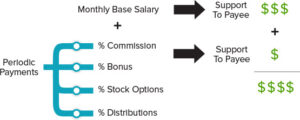
The Ostler-Smith Order
Are There Any Situations Where a Party Is Not Required to Serve the Other Party the Final Declaration of Disclosure?
Although a party is required to serve the other with the final declaration of disclosure, this rule may not be required if the judgment or agreement is executed before the petition for divorce is filed with the court (IRMO Evans).
Even if a final declaration of disclosure is not required, or is waived, the same fiduciary duty disclosures of material facts and information exists.
Are There Circumstances Where a Party Will be Required to Sell Assets to Pay Support?
The divorce court may require the payor spouse to liquidate capital assets to pay support and meet the martial standard of living if that was the practice during the marriage (IRMO Deguigne).
Are There Situations Where a Change of Circumstances is Not Required for a Court to Modify the Child Custody Order?
Divorce courts will not modify temporary child custody orders unless there is a substantial change of circumstances since the last order. In fact, divorce courts are reluctant to make changes in temporary custody orders under any circumstances, unless a child’s safety is involved. Divorce courts seek to have only one child custody trial.
In some situations, the simple changing of the residential arrangements (timeshare) may not constitute a change in child custody. In this situation, a showing of a substantial change of circumstances may not be required (IRMO Birnbaum). Some minor changes in a schedule may not be a change in custody, and may not require a substantial change in circumstances.
Are There Situations Where the Community is Credited With or Reimbursed a Portion of the Other Party’s Separate Property?
When community and separate property, money and/or services are commingled, there may exist an issue as to whether the asset is separate, community or mixed. A family law court may be asked to apportion an increase in the value of an asset between community property and the separate property of one party in an equitable manner. There may also exist an issue as to whether there is a right to reimbursement relative to the separate or community estate. The determination of these issues is fact driven. Gray areas are often decided in the divorce courts in favor of the community. These issues are often determined based on which party has the “burden of proof.” There are presumptions that favor the community estate and there are presumptions that favor the separate estate. Some presumptions may be overcome with evidence. Family law courts may be required to rule on characterization and apportionment issues relative to bank accounts, brokerage accounts, stock options, businesses, real estate and many other assets.
An example of equitable apportionment may exist when, during the marriage, when a spouse works in his or her separate property business that increase in value during the marriage. The community may be entitled to a portion of the increase in value of the business during the marriage.
Are There Specific Requirements for the Validity of a Premarital Agreement That Are Different Than Other Contracts?
To be a premarital agreement, it must comply with a number of requirements. Premarital agreements must be “acknowledged,” or its equivalent. (IRMO Cleveland). There must be at least seven days between the premarital agreement’s first presented and it being signed. (IRMO Cadwell-Faso & Faso and IRMO Clarke & Akel). A failure to comply with these, and others requirements will result in the agreement being invalid. Premarital agreements have specific requirements and are different than other contracts due to the relationship of the parties and the public policy, to protect people in these situations.
Are You and Your Spouse Both Candidates for Mediation?
In order for a mediation of an Orange County divorce to be successful, the parties must both be good “candidates” for the mediation process. Being a good “candidate” generally means that both parties:
- ARE WILLING TO ALLOW THE OTHER PERSON TO RECEIVE 51% OF THE ASSETS;
- Do not have a psychological need to WIN;
- Trust each other. Divorce mediation is not a process that is designed to verify facts, investigate financial issues and question suspect expenditures. If there is a lack of trust, divorce mediation is not the correct model;
- Are not hostile personality types. If one party is essentially a bully, mediation will not be “successful,” unless the other party simply gives in to the bully. In that case, the divorce mediation is “successful” because it resolved the issues, not because a fair settlement was agreed to;
- Are both ready to end the relationship. If both people are not ready to move on with life, divorce mediation will be a waste of time and money. A divorce mediator does not have the power to force a settlement. To reach an agreement both people must have a desire to reach a fair resolution on all issues;
- Are both ready to resolve the issues. If either party is angry with the other or has a need to delay the resolution, divorce mediation will most likely not be successful. Anger on the part of a spouse makes mediation, essentially a non-starter;
- Have not been victims of domestic violence or abuse in the relationship;
- Have essentially equal personal power in the relationship. Divorce mediation involves negotiation. Generally, the parties do not have lawyers physically present in the divorce mediation sessions and thus the party with more power and better negotiating skills prevails.
- Have essentially equal access to and understanding of the finances. Except in the area of child custody, a divorce is a financial transaction. The party with less knowledge and less experience with financial issues is at a severe disadvantage in divorce mediation. Failing to understand the financial aspects of a divorce may result in the receipt of less child support and less spousal support than should have been agreed to and it may result in an unequal property settlement.
- Define “fair” in a similar way. Many people proclaim a desire to want a fair deal but differ on what they feel is fair. In fact, the definitions can be and usually are extraordinarily different in the context of a divorce.
Are You Looking for a Divorce Lawyer That Will Help You Get Revenge?
If you are seeking to retain an aggressive lawyer for revenge or out of anger or spite, you will likely regret your decision. This logic will most likely significantly increase your attorney’s fees without improving your results. Judges often punish lawyers and clients who fail to act civilly. Courts may sanction clients who take unreasonable settlement positions. Civility is an issue that courts take very seriously.
Are You Looking for a Lawyer Who Will Protect Your Rights?
You may believe that your rights will be better protected by retaining an ‘aggressive divorce attorney,’ without understanding the nuances and meaning of the term ‘aggressive’ in the context of a divorce. This article explains the differences between an assertive, strategic divorce attorney and an ‘aggressive divorce attorney.’
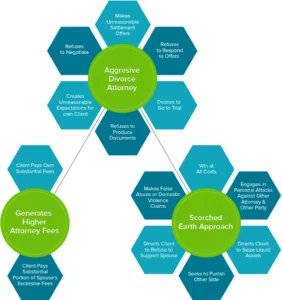
If you are seeking to retain an ‘aggressive divorce attorney,’ you should ask yourself what that means to you. To many, the word “aggressive” means junk-yard-dog style lawyering.
Attorney’s Fees Decision Tree
Courts may order one party to pay all or a portion of the other party’s attorney’s fees, costs, and expert fees if the court finds that such an order is necessary to level the litigation playing field. Family law courts look to each party’s respective assets and income together with the relative need of the requesting party. The courts must consider all of the section 4320 factors in the analysis.

Attorney’s Fees Decision Tree
Can a Court Consider a Previous Pattern and History of Using Separate Property Assets to Pay Community Expenses When Setting Child Support?
If a payor has a history of using their separate property assets (capital) to create and maintain a standard of living, the divorce court may fashion a child support order requiring their to continue that practice. (IRMO Deguigne).
Can a Court Grant Mutual Restraining Orders?
For a protective order to be issued pursuant to the Domestic Violence Protective Act, the family law court must issue the required findings of fact. This requirement also applied to mutual restraining orders (Monterroso v. Moran).
Each party must request a Restraining Order for a mutual restraining order. A family law court does not have jurisdiction to issue restraining orders against each party, unless each party has requested such relief in their respective pleadings (Isidora M. v. Silvino M.).
Can a Court Impute Earnings on Assets When Calculating Guideline Child Support?
A family law court may impute income on the assets of both parties in calculating a child support order. (IRMO Dacamus, IRMO Destein and IRMO Sorge). The increased and unrealized equity in a payor’s residence is not income.
Can a Court Impute Earnings to a Party Who Reduces His Income or Quits His Job for Good Faith Reasons, When it is Calculating a Child Support Order?
If a party voluntarily terminates his or her employment, a family law court may impute income to that person at the previous level of earnings in calculating guideline child support. (IRMO McHugh). The family law court need not find bad faith on the part of the payor to impute income to that party. (IRMO Padilla). A spouse’s motivation for reducing available income is irrelevant to the divorce court’s ability to consider a payor’s earning capacity in determining the amount of child support. (IRMO Hinman).
Can a Court Require a Party to be Examined by a Vocational Rehabilitation Expert?
A divorce court may order a spouse to participate in a vocational examination to evaluate their ability to earn an income and become self-supporting.
Can a Court Tax Impact the Accounts Receivable?
Should the excess earnings and/or accounts receivable be tax impacted? The impact can be significant to business valuation. Tax impacting relates to attempting to compare apples to apples when valuing C-corporations and S-corporations which are taxed differently. A C-corporation pays tax, while the profits of an S-corporation pays no tax and passes the income on to the owners, who pay the tax. The multiplier and the income stream should both be pre-tax or both be after-tax.
Can a Domestic Violence Action be Filed in a Divorce Action?
Domestic violence actions may be filed in the family law court and impact other parts of a case, including child custody, child support, spousal support, and attorneys fees. A finding of domestic violence does not necessarily require a physical touching and there is a lower threshold for finding domestic violence in family court than in criminal courts.
Can a Domestic Violence Action Have Significant Impact on a Party in a Divorce Case?
Domestic violence actions are filed in the family law courts under the Domestic Violence Prevention Act (DVPA). Courts have differing views as to what constitutes domestic violence, and thus it is critical to avoid any conduct that could potentially be construed as domestic violence. A finding of domestic violence may impact a court’s orders regarding spousal support, child custody, child support, and attorney’s fees. Additionally, a finding of domestic violence often leads to a presumption that the perpetrator is the “bad party.” Making false allegations of domestic violence is a bad strategic decision, and may backfire resulting in severe consequences.
Can a Failure to Comply with the Terms of a Pre-Nuptial Agreement Invalidate the Agreement Itself?
Depending on the circumstances, a party’s failure to perform certain obligations under a premarital agreement may be a defense to prevent its enforcement. (In re: Warner’s Estate).
Can a Fake Video be Found to Disturb the Peace of Another?
An appellate court found that purposefully sending a video of a staged, fake suicide to a spouse was conduct that disturbed the peace of the other party, and was abuse under the Domestic Violence Protective Act (Hogue v. Hogue).