Frequently Asked Questions Regarding Family Law Matters
Our FAQ section offers detailed information about a full range of important questions that affect divorce cases. The responses address key subjects including business valuation, child custody, spousal support, modification of orders and more. Click on the dropdown menu for a full list of topics, then choose the specific questions applicable to your situation.
Questions related to:
Can a Family Law Court Base a Child Custody Order on Economic Circumstances?
A child custody order may not be made based on the comparative economic circumstances of the parents (Burchard v. Garay).
Can a Family Law Court Change the Residential Arrangement of Children Without the Existence of a Change of Circumstances?
If the divorce court is simply changing the residential arrangement of a joint custody order, the matter may not be characterized by the court as a custody modification and a change of circumstances may not be required, even if the order is final. (IRMO Birnbaum).

Best Interests of Child
Can a Family Law Court Deduct Embedded Taxes in an Asset When Dividing Community Property?
Embedded capital gains tax relative to an asset are not deducted from the fair market value of the asset in a divorce. The deduction of the tax from the value of an asset in a divorce is limited to situations where the tax is immediate, specific, and arising out of the divorce itself. If an asset is being awarded to a party in a divorce, and that asset is not being sold pursuant to the divorce judgment, there is no deduction from fair market value relative to the tax. Speculative, future tax consequences are irrelevant to the valuation of assets, if the value is determined by the divorce court in a trial. The one exception is tax related to stock options. This exception is due relates to the fact that stock options have no intrinsic value unless and until they are exercised, as opposed to other assets whose value is not dependent on a sale. There is also an issue as to whether the divorce court should tax impact earnings in the valuation of a business.
Can a Family Law Court Impute Income to a Party That Is Not Actually Being Earned?
Appellate court divorce cases support the imputation of income to a party, if the facts warrant such action. The burden to prove that a party is deliberately depressing their income or could earn more money, is on the divorce lawyer representing the party seeking to prove underemployment (IRMO Regnery).The cases are split on whether the motive for suppressing one’s income is relevant (IRMO Meegan [Yes] / IRMO Ilas [No]).
The attorney representing the party seeking to impute income must prove the earning capacity of the other party (IRMO Flaherty).
A divorce court may impute earnings to a party who has intentionally reduced their income, but it must do so based on a normal work regimen for a person holding a similar job, and may not impute income assuming excessive hours or overtime (IRMO Simpson).
Income may be imputed to a party who voluntarily leaves a job, at the level of prior compensation (IRMO McHugh). The divorce court need not find a bad faith motive on the part of the payor in order to impute income on that party (IRMO Padilla).
Income may be imputed to the custodial party, only if the imputation is consistent with the children’s best interests (IRMO Ficke / IRMO Labass and Munsee / IRMO Hinman).
Voluntarily deferring income is not a basis for a modification of spousal support (IRMO Berger).
The divorce court may not impute income to a party after the age of 65 (IRMO Reynolds).
Can a Family Law Court Look to a Payee’s Entire Work History Since Separation in Determining Whether to Modify Spousal Support?
In a modification context, the divorce court may look to the payee-spouse’s entire employment history, to determine the payee’s good faith in attempting to obtain reasonable employment and become self-supporting, not just the conduct since the last hearing (IRMO Schaffer).Even without bad faith, failure to make reasonable efforts to seek employment may justify a divorce court’s decision not to extend spousal support (IRMO Sheridan). Irresponsible financial management may justify the termination of spousal support and jurisdiction (IRMO McElwee) by a divorce court.
Can a Family Law Court Make a Spousal Support Order Non-Modifiable?
All divorce court’s orders are modifiable, unless they were made non-modifiable by a stipulation of the parties. A divorce court cannot make a spousal support order non-modifiable, without the consent of the parties (IRMO Zlatnik).
Can a Family Law Court Make an Order That Reduces Spousal Support to Zero?
A Judgment that reduces spousal support to zero at some point in the future is a jurisdictional stepdown order. Such a divorce court order must be supported by evidence that supports a finding that the payee-spouse will not have a need for spousal support on the date of the stepdown to zero.The divorce court may order that spousal support shall terminate on a specific future date, unless the supported spouse asks the court to extend support before the termination date (IRMO Richmond).
Can a Family Law Court Make an Order That Reduces the Spousal Support After a Period of Time?
A Judgment that provides for a future reduction in the amount of spousal support is a “substantive stepdown.” The divorce court may stepdown the amount of spousal support payable by the payor-spouse only if the evidence supports a finding of a reduced need of the payee-spouse on the date of the future spousal support stepdown.
Can a Family Law Court Modify a Non-Modifiable Spousal Support Order?
Spousal support orders are modifiable by the divorce court unless they specifically and clearly indicate that they are non-modifiable. If a spousal support order is designated as a non-modifiable order, the divorce court loses the ability to modify spousal support upwards or downwards regardless of the hardship that has occurred or may occur in the future. A divorce court cannot make an order for non-modifiable spousal support but parties may agree to such a provision.
Can a Family Law Court Order One Party to Pay the Attorneys Fees of the Other Party in a Domestic Violence Action?
The family law court may order one party to pay the attorney’s fees of the other in a Domestic Violence Protective Act action. On appeal, the family law court’s order will not be reversed, unless the court has abused its discretion and the order “shocks the conscious” because of the amount of the award (Loeffler v. Medina).
The failure to ask for an attorney’s fee award in a Domestic Violence Protective Act matter does not prevent a party from seeking a fee award after the Domestic Violence Protective Act order is issued.
Can a Family Law Court Order Spousal Support Payable on Fluctuating Income?
If the payor spouse receives commissions, stock options, bonuses or other fluctuating forms of income, the spousal support order may be structured by the divorce court with a base spousal support payment and a supplement spousal support payment, payable if and when the additional income is received. The supplemental spousal support payments are referred to by divorce courts as “Ostler-Smith” payments (IRMO Ostler and Smith).
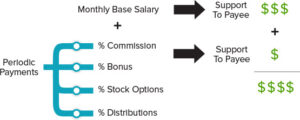
The Ostler-Smith Order
Can a Family Law Court Require That a Portion of the Guideline Child Support be Set Aside for the Child’s College Expenses?
A family law court may not order that a portion of the guideline child support be paid into a trust for a child’s future expenses or college. In the Orange County family law case IRMO Chandler the Court of Appeal made it clear that a family law court does not have the discretion to designate a portion of guideline child support be saved for college expenses, regardless of how large the child support is, and regardless of how small the contribution to an educational trust is.
Can a Parent Agree to a Child Support Order and Seek to Modify the Same Order the Next Week?
All child support orders and all parts of child support orders are modifiable by family law courts if the circumstances warrant a modification pursuant to the family code. The parties may agree to any level of child support they choose. However, such an agreement is not binding on either parent or the divorce court. A child support order that specifically and clearly states that it is non-modifiable is still modifiable. In other words, the parents can agree to a child support order that is below the guideline level and further agree that they will not seek to change the child support amount and the payee-parent could petition the divorce court the following day for a modification of child support to increase child support to the guideline level and generally that request will be granted. A child support order that is below guideline child support may be modified to the guideline number without a change in circumstances.
Can a Parent Relocate a Child’s Residence Without a Court Order?
If one parent attempts to relocate the child’s residence, the child custody orders, will necessarily have to be modified. A party will, of course, be able to relocate their own residence. The question will be whether that parent will be allowed to change the residence of the child. When a divorce court makes the determination as to whether a parent may relocate a child’s residence, the divorce court must assume that the parent will move, regardless of whether that parent is allowed to relocate the child’s residence. The divorce court cannot make an order that provides for one custody order if the parent moves, and a different custody order if the parent elects not to move after learning of the court’s order.
If a parent has substantially more physical child custody time than the other parent, the moving parent does not need to prove that the move is necessary. (IRMO Burgess). The parent opposing the move must show that the move would be detrimental to the child. If detriment is proven by the non-moving parent, then the divorce court must determine whether a relocation is in a child’s best interests or whether a change of child custody to the non-moving parent is in the child’s best interests. In other words, the family law court must make a determination as to which parent the child will live with after the anticipated move.

“Move Away” Case
Can a Party Obtain an Order That Retroactively Modifies Spousal Support?
Spousal support may not be modifiable to a date that precedes the filing of the Request For Order (RFO) filed with the court to modify spousal support.

Spousal Support Retroactivity
Can a Party Waive the Right to Disclosure?
Parties cannot waive the Preliminary Declaration of Disclosure but can waive the Final Declaration of Disclosure. However, a mutual waiver of the final declaration of disclosures does not relieve a party of the duty to disclose all material facts and information about all community and separate property and debts.There must have been an opportunity to know the full extent and nature of the assets and net worth of the opposing party. Each party must disclose all material facts and information relative to community property and his or her separate estate. However, one court ruled that if a spouse waives the opportunity to investigate the extent of the assets and debts, a post-marital agreement will not be set aside unless there was a misrepresentation or concealment of the facts.
Can a Pre-Nuptial Agreement be Valid for Two Marriages Between the Same Two People?
A premarital agreement executed before the first marriage does not apply to a second marriage with the same person. (Barham v. Barham).
Can a Prenuptial Agreement Alter Community Property Laws Related to Gifts Between Spouses?
To be valid, gifts between spouses must meet the specific qualifications of the California Family Code. A clear intention, by itself, to give an item to a spouse, may not replace or overcome the requirements of the Family Code. There are no restrictions on gifts of apparel, jewelry, or other tangible articles of personal nature principally used by the recipient spouse that are not substantial in value, considering the economic circumstances of the marriage.A vehicle of any price cannot be characterized as a gift, as it is not a tangible article of a personal nature. Whether items of art or furniture can be items primarily used by one spouses are questions of circumstance.
Premarital agreements may alter the rules relative to the definition gifts.

Intention by Itself is Not Sufficient to Make a Gift a “Gift”
Can a Separate Property Business Become a Community Property Business During a Long Marriage?
If a business is acquired prior to the date of the marriage, it will be characterized as the owner’s separate property.
If a business is acquired during the marriage, it will generally be characterized as community property. The characterization of a business will not change during the marriage, unless there is a transmutation by written agreement of the business itself from separate to community.

![]()
Initial Characterization of Business
Can a Spousal Support Order be Based on New Mate Income?
The income of a new spouse is generally not a source for spousal support.