Frequently Asked Questions Regarding Family Law Matters
Our FAQ section offers detailed information about a full range of important questions that affect divorce cases. The responses address key subjects including business valuation, child custody, spousal support, modification of orders and more. Click on the dropdown menu for a full list of topics, then choose the specific questions applicable to your situation.
Questions related to:
Can The Process Of Ending A Marriage Be Illustrated?
The legal process of separation, divorce or nullity may be complex, and it can be hard to visualize the complete process. There are many steps between deciding to end a marriage and completing the process.This section was designed to illustrate the process as a road map to illustrate the ways in which a marriage may be terminated.
Can You Use Your Personal Accountant in the Divorce to Value Your Business?
It is not prudent to attempt to utilize your personal accountant to perform the valuation, even if they are experienced and qualified in the field of family law valuation. It is essential that the expert knows the divorce valuation nuances, as opposed to general valuation principles. It is also critical for the expert to have credibility with the divorce courts and be seen as unbiased and objective by the judge.
Characterization Of Deferred Compensation Allocation Of Stock Options
Stock options, restricted stock, stock appreciation rights (SARs), phantom stock and restricted stock units (RSUs) may be granted to employees as a part of a compensation package. Generally, these types of assets have a risk of forfeiture.
Child Custody Decision Tree
Child custody orders are comprised of two main components: Physical and legal child custody. Physical custody addresses a party’s physical time with a child, and legal custody addresses decision making. A parent may have joint or sole, legal or physical custody. Generally, parents are awarded joint legal custody. Most orders provide for specific periods of physical child custody being awarded to each parent. The actual time-share schedule and the percentage of time-share are more important than the label attached to the plan. The percentage of timeshare impacts the amount of child support.
- * Child Custody and Visitation
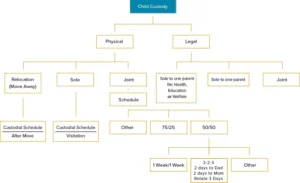
Child Custody Decision Tree
Basic “guideline” child support is calculated by a computer program that analyzes many factors. The main factors are the parties’ respective incomes and the child custody time-share percentages. Child support may be comprised of several different components: basic guideline child support, Ostler-Smith order (percentage of additional variable income), and “add-ons” (medical insurance, uncovered medical expenses, child care, etc.). Life insurance on the life of the payor may provide security for the payment of child support.
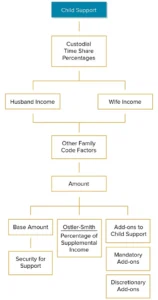
Cliff Vesting
There are three basic formulas (IRMO Nelson, IRMO Hug and IRMO Harrison) used to allocate options between separate property and community property. Generally, the community’s percentage interest in stock options that vest after the date of separation decreases as each year lapses.
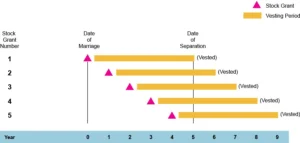
Cliff Vesting
“Divorce courts look to a number of factors in determining which formula to use:
- When was the grant made?
- Were the stock options granted to attract and retain the employee?
- Were the stock options granted for past service?
- Were the stock options granted to offset under-compensation?
- What are the forfeiture provisions?
- What are the vesting dates?
- What are the vesting provisions?
- Are the stock options designed as “golden handshakes” to retain the employee?
- What was the strike price at the time of grant?
- When did the parties separate?
- When did the parties marry?
- Were the stock options granted to replace other stock options?
“
Community Property Division Decision Tree
Assets must be characterized as separate property or community property.Separate property is owned entirely by one party or the other.
Community property is equally divided between the parties and is either awarded to one of the parties or sold. If an asset is acquired during the marriage, it is presumed to be community property.
If a party commingles or mixes community property with separate property, the combined property will be characterized as community property unless the separate property can be traced back to its original source using financial records.
A party that transmutes or transfers separate property into community property may be entitled to reimbursement.
If the asset is separate property, the community may be entitled to reimbursement and/or an equitable apportionment of any increase in value related to any community effort or money contributed to the separate asset.
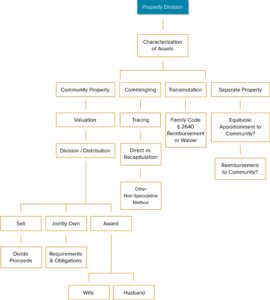
Community Property Division Decision Tree
Contact with Our Firm
Determination of Paternity
Designated persons have two years, from the date of birth, to attempt to rebut the conclusive presumption with genetic testing. The defined parties include:
- The husband;
- The presumed father;
- The child through a guardian Ad Litem; and
- The biological father as mother has filed an affidavit acknowledging parentage of the child.
Parentage may be established by a father executing an approved voluntary declaration acknowledging parentage. This is also known as the Paternity Opportunity Program (P.O.P.). The declaration has the same force and effect as a Judgment of Paternity.
Unless the P.O.P. is set aside by a family law court, it prevails over the aforementioned presumptions.
A voluntary declaration may be nullified by a family law court in one of the following ways:
- Filing for a rescission (Family Code § 7575) with the Department of Child Support Services within 60 days of the execution of the form (unless a custody or child support had made in the interim)
- Within the first two years of a child’s life, a motion for genetic blood testing is filed (Family Code § 7575(b)) by the Department of Child Support Services, the mother, or the person who filed the declaration of paternity. If it is determined that a biological father-child relationship does not exist, the family law court may set aside the voluntary declaration, unless the court determines that the set aside is not in a child’s best interests, taking the following factors into consideration:
- Child’s Age
- Length of time since signature of voluntary declaration
- Relationship between child and signer of declaration
- Whether the signer of the voluntary declaration has requested the parent child relationship continue
- Whether the biological father has indicated that he does not oppose the relationship
- Whether it would be beneficial to establish a biological relationship
- Whether the signature of the voluntary declaration has made it more difficult to find or obtain support from the biological father
- Or other relevant factors
Parentage can also be determined in an action to determine child custody or support, and it can be determined in a motion for genetic tests, per Family Code Section 7630.
A voluntary declaration can be set aside by a family law court per Code of Civil Procedure Section 473 (mistake, excusable project, or in advertence) per Family Code Section 7575(c).
A voluntary declaration may be set aside in a family law court by a motion filed by the presumed parent, under Family Code Section 7612, within two years of execution. The family law court will take into consideration the following factors:
- Validity of the voluntary declaration
- Best interest of the child (Family Code § 7575(b))
- Best interest of the child, based on the child’s relationship with the presumed parent, and the benefit or detriment of continuing that relationship
- If conflicts exist between a voluntary declaration and Family Code Section 7611, the court will look to logic and policy considerations
Do All Courts Handle Child Custody Matters the Same Way?
A divorce lawyer must be acutely aware of the way the judges view child custody issues. Judges are people and different people, have different philosophies about child custody, move away issues, Evidence Code Section 730/Family Code Section 3111 evaluations, parenting, etc. The various branches of the Superior Court in the State of California are not uniform in the area of child custody litigation. There are distinct differences between the counties as to how child custody and child visitation matters are determined.

Evidence, Presumptions and Privileges
Do All Divorces with Complex Issues End Up in Trial?
A divorce may involve little to no community property, and cases of this type may be resolved very quickly, inexpensively, and possibly without the services of a divorce lawyer. Other times a divorce may involve extremely complex issues that practically require the involvement of a divorce lawyer and other experts. Cases of this type often resemble business litigation between partners. However, complexity itself does not mean that the matter will involve a trial. Many complex matters are resolved amiably, without the involvement of a judge or a trial.
Do Divorcing Parties Owe Each Other the Same Duties That Partners Owe Each Other?
Fiduciary duties owed by each party to the other require full disclosure of all relevant material facts, and information regarding both community and separate property assets and debts. There may be harsh penalties for breaching these duties.
Parties to a divorce should be prepared to make voluntary, full and immediate financial disclosures to their spouses, as required by their fiduciary duties. The fiduciary duties require each party to act with the utmost good faith toward the other. Both spouses are bound by fiduciary duties to one another during marriage, until the divorce has been finalized and the property is divided. Sections 721(b), 1100(e), and 2100(e) of the California Family Code set forth the rules and requirements. Essentially, these are the same fiduciary duties that are set forth in the California Corporations Code. Divorcing spouses are treated like business partners in this respect.

![]()
Fiduciary Duties
Do Domestic Violence Orders for Child Support and/or Child Custody End When the Restraining Order Terminates?
Court orders relative to child support and child custody survive the termination of a Domestic Violence Restraining Order’s termination (Moore v. Bedard).
Do Family Law Courts Consider the Income of Cohabitants When Setting Child Support?
Divorce courts may not consider the income of non-marital partners in setting child support except in situations where to not do so would result in extreme hardship to a child. Such a circumstance could exist where a parent with a child support obligation terminates his or her employment when he or she commences cohabitation with a person with a substantial income.
Cohabitation cannot result in a non-parent being liable for child support except in unusual circumstances where a party represents to a child he or she was the child’s natural parent.
Do Family Law Courts Determine Parentage?
Parentage or paternity matters are resolved in the family court, along with child support and other child related issues.
Family law courts have jurisdiction to determine parentage. In other words, family law courts may determine the identity of the parents of a child using genetic testing. Once parentage is established, a person has all the rights of a parent, may obtain custody/visitation orders, and may be ordered to pay child support.
Parentage litigation is resolved in the family law courts. This area of the law is decided based on statutes, case law, and a number of very significant presumptions. The laws are designed to protect the best interests of the child and follow common sense.
Family law courts may determine the identity of the parents of a child using genetic testing. Once parentage is established, a person has all the rights of a parent, may obtain child custody/visitation orders, and may be ordered to pay child support.
Parentage law is decided based on statutes, case law and a number of very significant presumptions that are designed to protect the best interests of the child.
Paternity cases are heard in the family law court and often involve child custody and child support issues. The same law that controls these issues is in a divorce applies. The laws relative to paternity are based on the Uniform Parentage Act that was adopted in 1975.
Some of the presumptions are conclusive. It is conclusively presumed that the child of a wife cohabiting with her husband, who is not impotent or sterile, is a child of the marriage. This presumption may be applied by a family law court against an unmarried man who is the biological father of the child. A divorce does not impact this conclusive presumption. The presumption will be applied unless it would result in an illogical outcome. The presumption will not be applied against the biological father in favor of the presumed father where there was no relationship between the child and the man married to the child’s mother.
Do Mediations Often Fail?
One should consider the consequences and fall out of a divorce mediation that does not result in a successful and fair settlement.If mediation is not successful the parties will have incurred substantial unnecessary attorneys fees and there will have been a delay in resolving the divorce. Unsuccessful mediations often further polarize the parties which may increase the odds of ending up in expensive litigation.
If the parties are not good candidates for mediation they should not opt for that process.
Over the years, we have had many cases where clients have consulted with us after a failed divorce mediation. In some matters we learn that our new client walked away from an amazingly advantageous settlement due to a lack of understanding as to why the terms were so favorable to his or her position. We have had other cases, where a client entered into a disastrous settlement of their Orange County divorce that they were attempting to either set aside or modify.
Divorce mediation may be used as a very successful delay tactic by a strategic spouse. A delay in the resolution of a case can be a significant benefit to one side or the other. During a delay, a party may make financial decisions or position assets that may impact the ultimate divorce settlement. The timing of a divorce may be one of the most important issues. The use of divorce mediation to delay the resolution of an Orange County divorce can be a very successful tactic. For example: if the parties own a business, the delaying of the settlement or trial, will most likely, change the time frame over which the financial performance of the business will be measured. A different time frame will often result in a different valuation.
Do Most Divorce Cases Result in a Contested Hearing?
Family law issues may be settled or resolved in a trial or hearing. It is a misconception to think that retaining a divorce lawyer to represent you in a divorce will necessarily involve a hearing or a trial in your case. Most divorce cases that are technically “litigation” matters never proceed to a hearing or trial, and are settled between the parties or their lawyers.
One should hire a divorce lawyer who is capable of litigating a case involving the relevant issues, but who is settlement oriented, (if that is your objective0.
Any divorce case could end up in litigation, even cases that appear to be a guaranteed settlement. Often times, cases that appeared to be a guaranteed “war of the roses” will settle quickly. The direction a case takes often depends on which divorce lawyer is retained. See our sections “Selecting a Divorce Lawyer,” and “How to Speed the Process and Manage Attorney’s Fees.”
Do Opposing Experts Generally Agree on the Value of Goodwill?
Often times, the opinions of opposing experts are relatively close regarding the adjusted book value of a business but they rarely agree on the value of goodwill. The specific issues that experts generally disagree on are:
- Controllable cash flow;
- Reasonable compensation; and
- Multiplier/CAP rate
Do Parentage Laws Rely, in Part, on Evidentiary Presumptions?
Paternity laws are based, in part, on presumptions. It is conclusively presumed that the child of a wife cohabiting with her husband, who is not impotent or sterile, is conclusively presumed to be a child of that marriage. This presumption may be applied against a man who is the biological father of the child. A divorce or separation does not impact this conclusive presumption. The presumption will be applied, unless it would result in a bizarre and illogical outcome. The presumption will not be applied against the biological father, in favor of the presumed father, where there was no relationship between the child and the biological father.
Do Parents Have Discretion in Developing a Parenting Plan?
The parties may agree to a child custody parenting plan that is appropriate for their circumstances. If they do not agree, the divorce court will set the parenting plan that they believe is in the child’s best interest.
The objective in designing the custodial schedule is to meet the needs of the child and the parties. The practicalities of a child’s schedule and work schedules of both parties can make creating a mutually acceptable child custody time share schedule problematic. It is critical to understand that although each party’s work schedule and needs may change, once an agreement is reached, it is not easy to modify.

Child Custody / Parenting Plan Models
Do Parties Owe Fiduciary Duties to Each Other in a Divorce?
Fiduciary duties require each party to act with the utmost good faith toward the other in the disclosure of all relevant material facts and information regarding both community and separate property assets and debts. There may be harsh penalties for breaching these duties.