Frequently Asked Questions Regarding Family Law Matters

Our FAQ section offers detailed information about a full range of important questions that affect divorce cases. The responses address key subjects including business valuation, child custody, spousal support, modification of orders and more. Click on the dropdown menu for a full list of topics, then choose the specific questions applicable to your situation.

Questions related to:

All child custody orders are modifiable and all parts of a child custody order are modifiable. Even an order that specifically states that it is not modifiable, is modifiable. The divorce court will not enforce a non-modifiable child custody order, in that a non-modifiable order is deemed to be contrary to public policy.

Temporary child custody orders may be, but rarely are modified. Practically speaking, the divorce courts are reluctant to modify a temporary child custody order unless there is an issue related to the safety of a child. The divorce courts are very reluctant to dedicate the court’s resources for multiple temporary custody hearings.

Physical and Legal Custody

There are certain subject areas that cannot validly be included in a premarital or postmarital agreement. For example, the parties cannot provide for a penalty to a spouse for being sexually unfaithful. (Diosdado v. Diosdado). The parties cannot provide for forfeitures related to conduct like using illegal drugs. (IRMO Mehren & Dargan).

The law now allows for parties to contract with each other relative to the terms of a spousal support in a divorce in certain circumstances. This changes the prior prohibition of addressing spousal support in a premarital agreement. (In re Nelson’s Estate). However, a provision relative to spousal support will not be enforceable if a family law court determines that the provision is unconscionable at the time of the divorce.Pending the determination of the validity of a premarital agreement, a divorce court may grant temporary spousal support. (Gromeeko v. Gromeeko).

Proof of a past act or acts of domestic violence, together with credible evidence of the protected party’s continued fear, may warrant the issuance of a restraining order under the Domestic Violence Protective Act (IRMO Fregoso & Hernandez).

When parties enter into a premarital or postmarital agreement, there may be issues of interpretation and/or validity in a future divorce proceeding. There are specific presumptions that apply to these agreements, some of which are rebuttable and can be overcome with sufficient evidence. The law has changed several times over the years regarding the issues that may be addressed in a premarital agreement. It is critical to know the law as it existed on the date the premarital agreement was executed. (IRMO Melissa). If the parties do not agree as to the validity of an agreement, the divorce court will determine the validity. Trials on these issues can be extensive, and may involve issues related to unconscionably, the nature of the relationship between the parties when the agreement was executed, undue influence, voluntariness, lack of accurate disclosures, compliance with family code requirements regarding the execution of the premarital agreement, and issues of contractual interpretation.
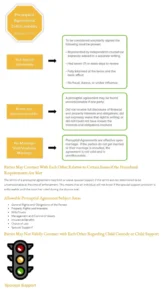
Prenuptial Agreements

Conduct that disturbs the peace of another or that causes another to be in reasonable fear of imminent serious bodily injury will justify the granting of a DVPA restraining order (Qing Hui Gou v. Bi Guang Xino and Perez v. Torres-Hernandez).

If an asset is purchased with funds obtained through the refinance of a jointly owned house that was originally the separate property of one spouse, upon divorce, that spouse may be reimbursed the equity that existed on the day the house was transmuted into joint names. If the spouse who originally owned the first house as separate property can trace the equity that they had in the first house that was accessed through a refinance and used to buy a second house, that party may be entitled to reimbursement (IRMO Walrath).

In other words, if a wife owned a home before the date of marriage and added the husband’s name on the title at a time when the equity in the home equaled $1,000,000, she could be reimbursed the portion of that $1,000,000 obtained from a refinance, if it was used to buy another home and she could trace the transaction.
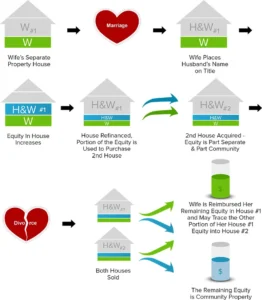
Refinance

Accessing, reading, and publicly disclosing the content of a text or e-mail of a party may be considered abuse under the Domestic Violence Protect Act and may disturb the peace and mental or emotional calm, constituting abuse. (IRMO Nadkarni)

The divorce court may order Family Code Section 271 sanctions be paid from spousal support as in spousal support is one of the types of income intended to be a source for sanctions, so long as the order does not create unreasonable financial hardship (IRMO Pearson).

Stock options are a form of compensation and if they vest, or partially vest, during the marriage, all or, a portion, of the options will likely be characterized as community property. There are several different formulas that are used to characterize stock options. The court has significant discretion in the selection of the formula, so long as the order accomplishes substantial justice.

Cohabitation of the supported spouse with a third party may constitute the basis for a modification or termination of spousal support by the divorce court. There is a rebuttable presumption of reduced need when the supported spouse is cohabiting. It is not necessary for the parties to be married to find cohabitation. It is the burden of the supported spouse to rebut the presumption of reduced needs, if cohabitation is found to exist.

Termination of Spousal Support

California family law dictates that the community may acquire an interest in real property if community funds are used to make principal payments on a mortgage secured by a residence owned solely by one spouse (IRMO Moore/IRMO Marsden). Payments on an interest only loan do not create a right to reimbursement or an ownership interest in the property.

If community money is used to improve a separate property, there may be a right to reimbursement.
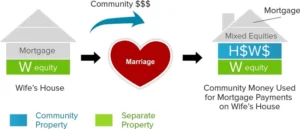
Community Money Used For Separate House

California family law dictates that the community may acquire an interest in real property if community funds are used to make principal payments on a mortgage secured by a residence owned solely by one spouse. (IRMO Moore / IRMO Marsden) The interest is a combination of the amount of the principal pay down on the loan and a pro-tanto interest in the increase in the value of the residence.

Community Money Used For Separate House

California family law provides for a reimbursement to the community of a portion of the increase in the value of a business owned by one spouse before the date of the marriage in certain situations.

The payor’s ability to earn is measured by the reasonable work regimen of a person in the same industry. A family law court cannot base the child support order on excessive overtime, if overtime is not actually being worked. However, if a person continues to work overtime or excessive hours, the court may base child support on the extra earnings.

The divorce court may use the Pereira approach in some years and the Van Camp approach in other years. (IRMO Brandes).

Pereira + Van Camp = Brandes

The court may split the difference between the Pereira and the Van Camp approach. (Todd v. C.I.R.).

In calculating the allocation/apportionment/reimbursement amount, divorce courts look to a number of factors: valuation on date of marriage, valuation on date of separation, other valuation dates, actual earnings, distributions of the business used for community purposes, personal expenses (perquisites) paid by the business, undistributed income, reasonable compensation, rate of return on separate property value, and compound versus simple interest.

The family law court may use one theory during a portion of the marriage, and another theory during a different portion of the marriage (IRMO Brandes). The family law court may also use a compromise formula (Todd v. C.I.R.).

Generally, if a separate property company increases in value during the marriage, and the increase is not due primarily to the effort of the owner-spouse, the community is only entitled to reasonable compensation for the work performed by the owner-spouse.

The divorce court may impute income on assets of either party.

A court may impute earnings on the payee’s share of community property income from a new marriage (IRMO Martin).

A divorce court may impute earnings on liquidated or sold assets (County of Kern v. Castle).

Child support may be ordered payable by the primary custodial party to the secondary custodial party. If the primary custodial parent earns substantially more than the other parent, the formula may generate a guideline child support payment payable to the secondary custodial parent. However, a court could deviate from the guideline child support amount and decrease or eliminate future support.

Permanent spousal support may have a number of different structures:

  1. Amount of the spousal support;
  2. Substantive stepdown (reduction in amount of spousal support at a later date);
  3. Jurisdictional stepdown (reduction of an existing spousal support order to an order with no payments but reserving to the payee the right to seek spousal support at a later date); and
  4. Reservation of jurisdiction (making no order for spousal support payments but reserving to the payee spouse the right to seek spousal support at a later date).