Frequently Asked Questions Regarding Family Law Matters

Our FAQ section offers detailed information about a full range of important questions that affect divorce cases. The responses address key subjects including business valuation, child custody, spousal support, modification of orders and more. Click on the dropdown menu for a full list of topics, then choose the specific questions applicable to your situation.

Questions related to:

The Domestic Violence Protective Act was enacted to also protect Domestic Partners from abuse. (Altafulla v. Ervin).

If a party is deliberately suppressing his or her income, a family law court may base the child support order on a party’s ability to earn an income as opposed to his or her actual income. (IRMO Labass & Munsee). However, a divorce lawyer alleging the suppression of income must prove the earning capacity of the other party. Before a court will impute income to a party it must be shown that the party has the ability to earn and that a job is available.

The marital standard of living is less important after a long period of separation (IRMO Rising).

After a decision to terminate a relationship has been made, one must decide what type of action to file: Divorce; Legal Separation; or Annulment and when to file it.**
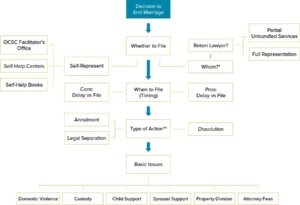
Decision to End Marriage

Spousal support may be modified based on the length of the marriage, depending upon the specific terms of the judgment.

An increase in guideline child support may be a factor in considering a reduction of spousal support. (IRMO McCann). The termination of child support may require an increase in spousal support. (IRMO Kacik and Family Code section 4326).

In determining whether to modify or terminate spousal support, the divorce court will look to the supported spouse’s history of seeking employment back to the initial divorce judgment, not just since the date of the last hearing that addressed the issue of spousal support. The divorce court will look to whether the supported spouse has made reasonable and good faith efforts to become self-supporting. (IRMO Schaffer II).

Generally, the income of the supporting spouse’s new spouse is not considered by a divorce court relative to a modification of spousal support, other than for tax brackets.

All spousal support orders are modifiable unless they provide specifically for non-modifiability. (IRMO Zlatnik).

Duration of Spousal Support

  • Is there any difference between domestic violence in the criminal courts and in the family law courts?
  • How do family courts define abuse
  • Who needs a restraining order
  • What does it mean to get a restraining order
  • How does one get a restraining order
  • What are the consequences to the abuser if a Temporary Restraining Order is issued
  • How long do restraining orders last
  • What are the consequences of making false accusations of domestic violence
  • Can delaying the request for a Temporary Restraining Order decrease the chance that it is granted
  • Is self-defense a defense to a request for a Temporary Restraining Order
  • Can women be found to have committed domestic violence
  • Can restraining orders be renewed
  • Can police or Homeland Security officers access past Domestic Violence Restraining Orders
  • Can domestic violence impact the amount of spousal support
  • Can domestic violence impact child custody orders
  • Who is eligible to be protected by a restraining order
  • Can disturbing the peace result in a restraining order
  • Is physical violence required for domestic violence to exist

Annuities generally fall into two categories: deferred and income.Tax deferred annuities are generally a part of future retirement planning. Withdrawals of taxable sums are subject to ordinary income tax. There are two different types of deferred annuities: deferred variable annuities and deferred fixed annuities. The owner of a deferred variable annuity has the option of investing the funds in a variety of investments, but with this option comes market risk.

Income annuities are utilized to generate income after retirement and offer a guaranteed income for life or for a set period of time. Immediate fixed income annuities provide for immediate guaranteed income and some annuities offer provisions that avoid market risk. Deferred income annuities have the same provisions as the immediate fixed income annuities except the payments commence on a future date.

Many annuities cannot be divided between the parties and must be awarded to one of the parties or terminated.

One of the most complex areas in family law is the valuation of a business interest and the determination and calculation of any equitable apportionment or right to reimbursement relative to any increase in value of a business that was owned by one party before the date of marriage.The court may award the business to either party and, although rare, it may order it sold or award it to the parties jointly. The valuation of a business generally requires the services of a valuation expert.

See our Business Valuation Practice Area Page

Family law courts are reluctant to spend their limited time and resources dividing furniture and furnishings. Courts are impacted due to budget constraints and simply do not have the resources to address these issues. Parties usually know the relative value (garage sale prices are generally used) of their furniture and furnishings and which items they value more than others. Generally, parties are able to agree upon a division of these items without the assistance of counsel or appraisers.

Personal injury proceeds arising out of an incident that occurred prior to the date of separation are characterized as community property but are often treated as the separate property of the injured spouse in most situations.Personal injury awards are characterized as community property in California divorces, if the injury occurs before the date of separation. Generally, the date of the receipt of the funds is not relevant to the characterization, and the proceeds are assigned to the injured party as if they were separate property. However, the divorce court does have the discretion to award a portion of the proceeds to the community. Courts take the following issues into consideration: the economic conditions, needs of each party, time elapsed since the recovery of the damages, the date of the injury, and any other relevant factors.

An allocation of a portion of proceeds to the community may occur if the community or the other spouse paid unreimbursed medical bills related to the injury or if there are lost wages related to the injury.

If the personal injury proceeds have been commingled with community funds, the injured party may still be awarded the proceeds, if the proceeds can be traced using family tracing principles that are somewhat relaxed when tracing personal injury proceeds.

Personal Injury

Personal Injury

California family law courts generally allocate retirement plan benefits between separate property and community property according to when the benefits were earned. Benefits “earned” during the marriage (after the date of marriage and before the date of separation) are generally characterized as community property. Benefits “earned” before the date of marriage or after the date of separation are generally characterized as separate property.See our Retirement Plan Valuation and Characterization Practice Area Page

In a California divorce, stock options and similar assets granted during the marriage and/or partially vested during the marriage may have a community property component. Stock options that are earned partially during the marriage are allocated between community property and separate property. The foundation for the allocation is the community property presumption that provides that “earnings” during the marriage are community property. If a spouse is compensated during the marriage, in part, with a grant of stock options that partially vest during the marriage, the stock options will most likely be partially community property. If a spouse’s employment during the marriage results in partial vesting of stock options granted before the date of the marriage, the options will also most likely have a community property component. The number of options allocated between separate property and community property can vary depending upon which formula is used.
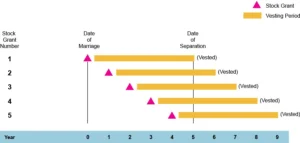
Cliff Vesting

Unvested stock options, or Restricted Stock Units, may be characterized as income once vested (IRMO Kerr and IRMO Macilwaine).

Family law courts can make orders related to many issues, but the granting of an order does not guarantee the order will be voluntarily complied with. California family law provides parties with a variety of tools to enforce family law orders.

Parties to family law matters can access the divorce courts to enforce orders through private attorneys, and in certain situations, through the Department of Child Support Services. Enforcement may be sought to enforce orders on child support, spousal support, payments due under the terms of family law order or judgment, custody/visitation, and other areas. Orders may be sought through a contempt, a writ of execution, a wage assignment, a receiver, a keeper, an abstract of judgment, and/or various other remedies.

Your initial consultation with an Orange County divorce attorney is of critical importance. In fact, you may find that this meeting is the most significant time that you spend with a divorce attorney. The advice you receive will likely impact some of the most important decisions you will ever make. You should expect to obtain information about the divorce process, the law related to your specific issues and the application of the law to your specific facts. It is important for you to prepare for the consultation in a way that recognizes the importance of the conference and that maximizes its value to you. In the conference, you will receive the information you need to make wise and logical decisions about your case and your future. Our objective is to begin strategic planning and case resolution in the initial consultation not many months later.

Doing the following tasks will greatly enhance the value and cost-effectiveness of the time spent with your Orange County divorce attorney:

  1. Review the relevant pages in the Practice Areas section of our website. Educating yourself before your initial conference will make the consultation far more cost-effective & efficient and will likely help you ask us better and more targeted questions in the conference. Our website was designed to give you the opportunity to learn about basic family law issues on your time as opposed to paying us our hourly rates to explain the basics. Our objective is for you to only pay us for advice on the nuanced, targeted and/or complex areas of family law. Our website is designed to save you money. It contains significant and meaningful information that many lawyers charge for.
  2. Prepare a written list of your questions, issues and concerns. This list should be viewed as a part of the agenda for our meeting. You may have preconceived specific ideas about the process and the law, please allow us to confirm your ideas and beliefs or to correct them.
  3. Bring a previously prepared financial statement or prepare a simple, handwritten list of your assets and debts. The list should identify separate and community property. Assets include business interests, partnerships, investments, bank accounts, real estate, vehicles, collectibles, life insurance, club memberships, retirement plans, etc. Debts include mortgages, pledges, lines of credit, credit card debt, pending lawsuits, taxes due, contingent liabilities, student loans, etc. Regardless of whether you have a high net worth or a modest estate, rough estimates are sufficient for the initial conference.
  4. Prepare a written bullet point outline or summary of facts that you believe we need to know. Topics might include your date of separation, child custody, domestic violence, separate property, etc. Topics may also include issues related to the formation, development and growth of a business. For our advice to be as accurate as possible and of maximum value to you, we need as much relevant information as possible. Carefully outlining the facts and/or providing us a timeline can be a significant time saver. A written summary makes it less likely that you will forget important details or that we will misunderstand one of your comments. The time spent communicating the information to your Orange County divorce lawyer will be a fraction of the time that would have been required to relate the facts to him/her orally.
  5. If you have been served with any court pleadings filed with the Orange County family law court that contain statements that are incomplete or incorrect, prepare a very detailed statement explaining your version of the allegations, events or facts addressed in the pleadings, paragraph by paragraph and point by point. Your statement should address the issues in the same order as set forth in the pleadings and should be rich in facts, dates, places, witnesses, circumstances, etc. The statement should not be a simple denial. Provide us with very accurate details and bring all court pleadings with you.
  6. Prepare a summary of your goals and objectives. What do you perceive as the real issues? What objectives do you want us to help you achieve? Do you or your spouse have a settlement proposal that we can help you analyze and evaluate?
  7. Provide us with the last three years of tax returns if they are readily available.

By completing the tasks listed above, you will allow your Orange County divorce attorney to provide you with the best and most comprehensive advice and early-stage analysis possible. It is not necessary for you to email your thoughts to us before the consultation. We believe we can provide you with significantly more relevant, individualized and targeted advice if you prepare for our meeting. Your preparation will make the initial consultation far more cost-effective, informative and efficient. If you communicate the facts and your objectives at the conference in a complete and organized fashion, we can spend more time in the meeting analyzing, strategizing, and problem-solving your issues, concerns, and questions.

Your meeting with us will be more efficient and informative if less time is spent gathering facts and more time is spent explaining the law to you and discussing potential strategies and solutions. Spending time planning and preparing for your consultation will be time extremely well spent.

We seek to have a positive long-term relationship with you for many reasons, including the fact that one of our goals is for you to highly recommend us to your friends and colleagues for many years to come. We are aware of the fact that many issues determine a client’s level of satisfaction, including the results, the amount of the attorney’s fees, the time required to complete the divorce, client service, and many other issues. Your fees will be less if you are organized and efficient in planning our consultations, provide us with the requested documents at your earliest opportunity, communicate with us immediately if there are areas of concern, take reasonable positions on the issues, and keep us informed as to your thinking, or changes in your thinking, on the relevant issues. Please see How to Minimize and Manage Your Orange County Divorce Lawyer’s Fees and Speed the Process.

It is critical for you to tell us the absolute and complete truth about all relevant issues. Please volunteer all of the relevant information, even if we do not ask a specific and important question on the topic. We rely on what you tell us in developing a strategy and a game plan to resolve your matter. If we do not know all of the facts, we will not be able to analyze your matter accurately. We do charge for our time in the initial consultation; however, you will not be asked for a retainer in the initial consultation, as that is our policy not to allow clients to retain us in the initial consultation. 

Please take a moment and review these sections in our website:

In order to change or transmute the character of property from separate to community, community to separate, or separate property of one spouse to separate property of the other spouse, there must be a written express declaration executed by the party adversely affected. The statement must be specific as to the item being transmuted. A promise by one party by itself, to transmute, transfer, or give an asset to the other party or the community does not result in a legal gift or transmutation.

Transmutation

If the parties cannot arrive at an agreement resolving all custody and visitation matters, the family law court will make the necessary decisions, including physical custody and legal custody. These orders are made after a hearing or trial, at which the parties’ other witnesses may testify. The court may make orders regarding a variety of other related matters, like education or the relocation of a child’s residence.

In determining guideline child support, the family law court must consider future bonuses, overtime and other periodic and fluctuating payments. The divorce court will frequently order the payor to pay a percentage of the fluctuating income to the custodial party as supplemental child support payments. (IRMO Ostler and Smith).

Vested but unexercised stock options may also be considered as income for child support purposes. (IRMO Kerr and IRMO Macilwaine).

Although a divorce court has discretion in deciding which time period of prior earnings to use in fashioning a child support order, the divorce court must use a representative sample period that reflects a realistic level of income that likely reflects future earnings. (IRMO Riddle).

Physical child custody addresses where a child physically resides, and the parenting time of each parent. A physical child custody order determines which parent has supervision rights and responsibilities for the child during designated periods. The parties may be awarded joint physical child custody, or physical child custody may be awarded to just one party. Joint physical child custody does not necessarily mean equal time sharing. A 70/30 time share could be labelled joint child custody. The parties may be awarded joint physical child custody, with one parent being designated as the primarily custodial parent.

Divorce courts in Orange County rarely split sibling’s between the parents. It is generally believed that it is in the sibling’s best interests to live together.

If one parent makes the decision to attempt to relocate the child’s residence, a child custody order must be modified, in one way or another. A party will, of course, be able to relocate their own residence, but that parent will not necessarily be allowed to change the residence of the child. When a divorce court is making a determination as to whether a parent may relocate a child’s residence, the divorce court must assume that the parent will actually move, regardless of whether the court allows the party to relocate the child’s residence. A divorce court cannot create two separate orders, one if the parent decides to move, and another if they do not. In other words, a divorce court must make an order that the child will live primarily with the moving parent, or primarily with the non-moving parent.

There is a great burden on a non-custodial parent who is attempting to modify custody and relocate a child’s residence. (Jane J. v. Superior Court).
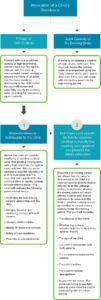
“Move Away” Case

In most lawsuits, one issue is being litigated and the relevant facts do not change during the pendency of the matter. Family law cases, on the other hand, involve a number of different issues. During the pendency of the case new events may occur or facts may change.For example, during the pendency of a divorce, circumstances impacting a child’s best interest may dramatically change or any number of different events may impact the value of a business. The housing market, the overall economy, or a party’s employment may change between the date of separation and the date of settlement or trial. These types of changes make resolving a divorce far more complicated than a situation where there is only one issue and all facts are static.

It is strategically critical to analyze each issue as it may relate to or impact other issues.

The infographics in this section should assist an individual in seeing the issues and sub-issues that may be relevant in each subject area.