Frequently Asked Questions Regarding Family Law Matters

Our FAQ section offers detailed information about a full range of important questions that affect divorce cases. The responses address key subjects including business valuation, child custody, spousal support, modification of orders and more. Click on the dropdown menu for a full list of topics, then choose the specific questions applicable to your situation.

Questions related to:

A Stepfather’s abuse of the father of a child, outside the presence of the child, did not constitute abuse under the Domestic Violence Protective Act (Hauck v. Riehl). That would justify classifying the child as a protected party.

An Appellate Court found that badgering may not be legally sufficient to justify a restraining order under the Domestic Violence Protective Act. (S.M. v. E.P.).

A child custody case is not simply establishing a time-sharing schedule. Child custody issues and orders may impact whether a parent can relocate to obtain a better job. Child custody orders relate directly to the amount of child support ordered, and other related issues. As the time share percentage of the payor decreases – child support may increase. As income of the payor increases – child support increases. The terms of a child custody order, and the amount of child support, may impact decisions as to whether to retain the family residence. Retaining a family residence may impact decisions about seeking an award of other assets.

There are many decisions that must be made relative to child custody matters. A person should have all of the relevant facts before making decisions about the children. The analysis should be made with a person’s divorce lawyer, therapist, and advisors. Many decisions relative to child custody impact other decisions related to child support, property division, etc. Careful consideration should be given to personal preferences, every day practicalities, and the children’s short term and long term best interests.
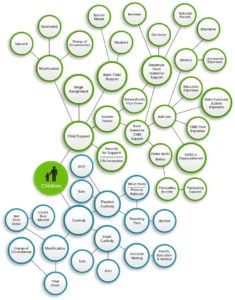
Family Law Interconnectivity Overview – Children
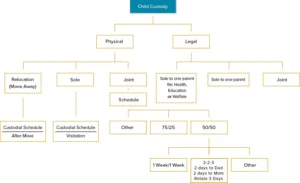
Child Custody Decision Tree

Child custody orders are always modifiable. The parties cannot validly contract with each other to not seek to modify or change the child custody arrangement in the future. The divorce court always retains jurisdiction to change child custody orders. (IRMO Goodarzirad).

Generally, the divorce court will only modify “final” child custody orders if there is a showing of a substantial change in circumstances between the date of the existing order and the hearing. (Montenegro v. Diaz). If the order is not “final”, the divorce court will base its decision for modification on the “best interests” of the child. Additionally, the parties cannot bind the family law court to follow a specific standard of review at future custody hearings.

Spousal support may be modified or terminated if the payee-spouse is cohabiting in a romantic relationship. There is a rebuttable presumption of reduced need when cohabitation exists (IRMO Regnery). To rebut this presumption, the divorce lawyer representing the cohabiting spouse must prove that their client’s needs have not been reduced. The parties need not hold themselves out as married for the presumption to apply. Expenses such as vacations being paid for with joint funds, expensive gifts and paying for joint bills and household living expenses are relevant. A former spouse giving away services as a homemaker, housekeeper, cook, and companion are relevant issues.

Unmarried parties residing together may ultimately find themselves impacted by various laws that relate directly or indirectly to family law. Cohabiting in a romantic relationship subjects a person to the Domestic Violence Protection Act (DVPA) and cohabitation may create property rights from an express or implied agreement or contract. Rights arising out of cohabiting are based on contract law not family law.

California does not recognize common law marriage. There is no risk that cohabitation for any length of time will create marital property, marital rights or a marriage itself. No community property is created during cohabitation. Some other states recognize common law marriages that are created by cohabitation for a set number of years.

Child custody, child support, and spousal support orders are modifiable after the judgment is entered. A modification generally requires a change of circumstances, but there are exceptions.

Divorce courts have jurisdiction to modify child support orders, child custody matters, and spousal support orders, unless the parties have agreed that they are non-modifiable. Modifications are brought before the divorce court by the filing of a Request For Order (RFO).

Potential Procedural Steps in a Request for Orders (RFO) – Modification

Family law courts may renew a domestic violence protection order restraining order for five years, or make it a permanent order.

Continued abuse is relevant to the renewal of a Domestic Violence Protective Act restraining order (Perez v. Torres-Hernandez and Ritchie v. Konrad). The renewal of a restraining order must be based on the protected party’s likely future abuse, taking into consideration any change in circumstances (Ritchie v. Konrad and Cueto v. Dozier). Reasonable apprehension shall be objectively analyzed. The burdens on the restrained party may, or may not, be relevant.

A fear of physical abuse by the protected party is not a requirement to renew a Domestic Violence Protective Act restraining order (Eneaji v. Ubboe).

The family court may renew a restraining order issued by the juvenile court (Garcia v. Escobar and Priscilla v. Leonardo G.).

An appeal of a family law court protective order under the Domestic Violence Protective Act, must be filed within 60 days after entry of the judgment, or within 180 days if service was not proper (IRMO Lin).

These decision trees were designed to provide a holistic view of family law issues from a different perspective and to put the component parts in a logical format, for clarity.

A party may be sanctioned pursuant to Family Code section 271 or Family Code section 2032(b) [soft sanctions] for bad faith conduct, breach of fiduciary duties, lying, misrepresentations, excessive settlement demands, frivolous conduct, failure to comply with local rules, conduct that increases the cost of litigation, unprofessional or uncivil behavior, harassment, failure to cooperate or obstreperous conduct may result in a sanction order. Sanctions may be granted pursuant to Code of Civil Procedure sections 128.7 and 128.5 against an attorney or a self-represented party if:

  • The pleadings submitted to the family law court are for an improper purpose, such as to harass, cause unnecessary delay, or to needlessly increase the cost of litigation
  • The claims or defenses are not warranted by existing law
  • The allegations do not have and are not likely to have evidentiary support
  • The denials of factual contentions are unwarranted

Click here to learn about Managing Your Legal Costs.

The answer to this question depends on your resources, the rates of the lawyer you wish to retain and what tasks you are retaining the divorce lawyer to perform.

Consider whether it makes sense in your case to retain an Orange County divorce attorney to just handle the most important issue.

Read our section on How to Minimize and Manage your Orange County Divorce Lawyer’s Fees and Speed the Process. The amount of attorney’s fees relates significantly to positions taken by a client and his or her level of cooperation.

Different lawyers charge different rates. The rates charged by lawyers generally relate to a number of different things, including: years of experience, type of experience, type of cases the lawyer typically handles, geographic area and their overall reputation. However, some lawyers bill at rates that are above or below their competence level. Just because a divorce lawyer bills at a high hourly rate does not mean that he or she is a competent divorce lawyer or that he or she is experienced in the specific issues involved in your case.

It does not make sense to retain a lawyer with a rate of $650 per hour if your matter is a modification of a child support order where both parties are W-2 wage earners and there are no complexities. The hourly rate that a client pays should roughly match the complexities of the issues involved in the case.

If you determine that you need or want to retain a lawyer, perform research on the internet and utilize other resources to determine the rates lawyers charge in your geographic area. The hourly rates that private practice Orange County divorce lawyers charge for handling family law matters ranges from $250 per hour to $800 per hour.

One question that you will want to ask yourself is what are the potential financial consequences of not hiring a lawyer? What if hiring or not hiring a divorce lawyers made a difference of $2,000 per month in the amount of a spousal support order over a 15-year period? What would the cost of not having a divorce lawyer be?

What if you elected to be self-represented, your spouse hired a divorce lawyer, and the court awarded your spouse 80% child custody? If you determined that the reason for the 80% order, in large part, was your not knowing how to respond to your spouse’s divorce attorney’s objections in court and could not get your story and the facts into evidence, what would the cost of not having a divorce lawyer be?

If the facts of your case call for the assistance of a lawyer, the real question may be, can you afford not to retain a divorce lawyer?

Yes, you can represent yourself and a significant percentage of people filing for divorce are self-represented and in some situations, this may make economic sense. If there are not sufficient resources to retain an Orange County divorce lawyer, whether or not to hire a divorce lawyer is not a relevant question. You should not spend your last dollar retaining a divorce lawyer. This article will be helpful to people who elect to be self-represented. However, there are many reasons why representing yourself is often a very bad idea IF you can afford a divorce lawyer.

Lastly, if you elect not to retain an Orange County divorce attorney, utilize the Infographics & Practice Areas of our website to help you spot and learn about the issues that are relevant to your case. For example, if you and your spouse disagree about the date of separation, see the Infographic on the date of separation. This section will also help you understand why the date of separation may be important in your case. There are sections on spousal support, child support, child custody and most other relevant areas.

If there are no children and you do not own real estate, you may qualify for a ‘Summary Dissolution.’ Although it may make sense to meet with a divorce lawyer briefly to confirm that there are no complexities and that you qualify, summary dissolutions are designed to be used without the necessity of retaining an Orange County divorce lawyer. This can be an inexpensive way to dissolve a short marriage. It is critical to understand whether it is to your benefit to utilize this procedure. Just because the procedure is simple and inexpensive does not mean it is the best solution. For example, you may qualify for a summary dissolution and yet not understand your claim to a portion of your spouse’s retirement plan, your claim to credit for the payment of certain expenditures, etc.

Domestic violence allegations are extremely serious, and can be filed in family law court as standalone cases, or as part of a divorce proceeding. If the divorce court finds that domestic violence has occurred, there may be very severe consequences. The issuance of a protective order will be registered in the California Law Enforcement Telecommunications System (CLETS). CLETS can be accessed by law enforcement and criminal justice agencies. If the perpetrator has contact with law enforcement, they will run their name through the CLETS system and discover any protective order.

Domestic Violence

Evidence of mental abuse may be the basis for a protective order under the Domestic Violence Protective Act (“D.V.P.A.”). Mental abuse is relevant evidence in a D.V.P.A. proceeding. Controlling behavior and threats may be sufficient evidence to demonstrate the destruction of a party’s mental and emotional peace. (Rodriguez v. Menjvar).

Paternity cases may also involve other child custody issues and child support, which are both determined by the same laws that control these issues in divorces.

California Paternity laws are based on the Uniform Parentage Act (UPA), which was adopted in 1975, but is not limited to the provisions of the UPA.

The divorce court will not honor an agreement between the parties that designates a child custody agreement as non-modifiable. The divorce court always retains jurisdiction to modify all aspects of child custody orders.

In other words, the parties cannot prevent the divorce court from making orders in the future that modify the terms of their child custody agreement (IRMO Goodarzirad).

The parties cannot deprive the court of its ability to allow one party to relocate with a child (IRMO Abrams)

The parties cannot contract with each other to deprive the family law court of jurisdiction to order or modify child support for a minor child or disabled adult child. Such a contract would be void and against public policy (IRMO Lambe & Meehan).

The terms of a premarital agreement cannot bind a divorce court relative issues related to child custody or child support and the parties cannot bind the family law court to follow a specific standard of review, relative to future child custody matters. Nor can the parties cannot bind the family law court relative to move away/relocation issues (IRMO Abrams) or the standard of review for the modification of child support. (IRMO Cohen).